
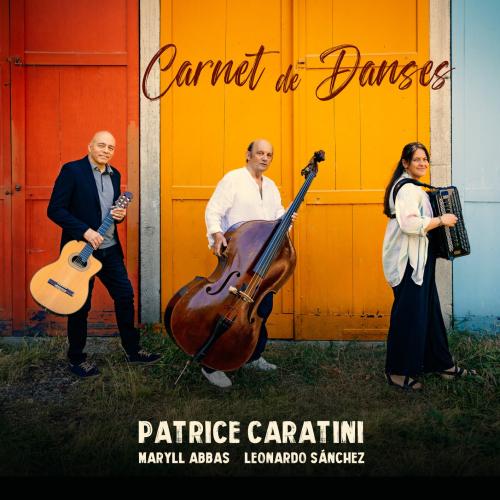
Carnet de Danses Patrice Caratini
Album info
Album-Release:
2026
HRA-Release:
20.11.2026
Label: Art District Music
Genre: Jazz
Subgenre: Latin Jazz
Artist: Patrice Caratini
Composer: Patrice Caratini (1946)
Album including Album cover
Coming soon!
Thank you for your interest in this album. This album is currently not available for sale but you can already pre-listen.
Tip: Make use of our Short List function.
- 1 50° à l'ombre 02:46
- 2 La barge rousse 04:18
- 3 Atlanta 04:22
- 4 Pan de Jarabe 02:46
- 5 Insolence 04:55
- 6 Hongroise 04:27
- 7 Sosiego 05:48
- 8 Fête à la Guadeloupe 02:54
- 9 Seresta 03:40
- 10 Lejos de Ti 03:44
- 11 Pinta 05:05
- 12 Zamba 04:02
- 13 Jour de pluie 03:52
- 14 Gazte 01:49
Info for Carnet de Danses
Let the music of the legendary Patrice Caratini get you dancing! At the age of 80, with 60 years’ experience on stage, Patrice Caratini returns to his first love: the compact double bass, which brings him closer to the dancers. ‘Carnet de Danses’ (Dance Notebook) brings the bassist together with Maryll Abbas (accordion) and Leonardo Sánchez (guitar), whisking them away into the world of dance music. Inspired by rediscovered old music books – those dance notebooks of yesteryear that once served as a memory aid for dancers – the concept draws on memories of Corsican dance halls from childhood and the sonic experiments of Duke Ellington. Argentine chacarera, musette waltz, Cuban comparsa, pasodoble, guajira, Guadeloupean biguine, zamba, Basque zortzico: the trio explores a soundscape where Latin America, the Caribbean and Europe converge. Enhanced by Caratini’s characteristic sparse instrumentation, ‘Carnet de Danses’ is a respectful and lively concert journey in which the art of a great orchestrator serves a simple pleasure: getting people to dance. ‘Let the music dance!’
Patrice Caratini, double bass
Maryll Abbas, accordion
Leonardo Sánchez, guitar
Please Note: We offer this album in its native sampling rate of 48kHz, 24-bit. The provided 96kHz version was up-sampled and offers no audible value!
Patrice Caratini
A major figure on the French music scene, double bassist Patrice Caratini (born 1946) began his career accompanying prominent jazz musicians and popular singers. He went on to lead several projects concurrently, including the "Onztet" (active from 1979—marked by the album *Endeka*—until 1989), a duo with Marc Fosset, a tango-oriented trio (1982–2002), the "POM" ensemble (1992–1996), and, from 1997, the Caratini Jazz Ensemble. Alongside these endeavors, he composed works commissioned by various festivals and institutions, such as the score for the ballet *Fabulazione* (1988) and *La Rivière de Glace* (1997), written for the Orchestre Philharmonique de Radio France. With a broad appreciation for all forms of music, he has championed everything from *chanson réaliste* (traditional French realist songs) to Caribbean music, the latter explored in his 2009 project *Latinidad*.
Born in 1946 in Neuilly-sur-Seine, Patrice Caratini pursued his studies up to the *hypokhâgne* level (preparatory classes for the *grandes écoles*) while working various odd jobs, including a stint as a salesperson for the Presses Universitaires de France.
Ultimately, however, his passion for jazz took precedence. After earning a first prize in double bass from the conservatory in 1971—having already been performing in the capital’s jazz clubs since 1968—he went on to establish and lead the double bass program at the C.I.M. in Paris between 1976 and 1982, all while maintaining his duo with pianist Marc Fosset. Having accompanied jazz greats during their visits to France—such as Johnny Griffin, Kenny Clarke, Lee Konitz, Chet Baker, Dizzy Gillespie, and Mal Waldron, among others—Patrice Caratini has also lent his talents to the worlds of popular music (*variété*) and world music, working with artists ranging from Maxime Le Forestier, Georges Moustaki, Georges Brassens, Renaud, and Leny Escudero to Henri Salvador and Pierre Akendengué.
In 1979, the double bassist launched the Patrice Caratini Onztet, which soon recorded the highly regarded *Endeka*, followed by *Paris Faubourg* in 1982 and *Chansons Bleues* in 1989. Drawn to all forms of jazz—from swing and bebop to free jazz—Patrice Caratini also finds inspiration in the folk music of France and beyond. His collaboration with accordionist Marcel Azzola and his participation in a trio with pianist Gustavo Mosalini and bandoneon player Juan José Beytelmann (from 1982 to 2002) serve as notable examples of this.
Alongside his work as a musician, Patrice Caratini is a dedicated advocate who has been deeply involved on a national level, working to unite efforts and foster the development of jazz in France. He composed and arranged several works commissioned for festivals, including the brass quintet *Passages* (1984); the saxophone quartet *Fêtes* and the music for the ballet *Fabulazione* (created by the Josyane Rivoire company in 1988); the violin and orchestra concerto *Fragments* (1990); *Divers Petits Manteaux* (1991); and *Concert de Chenôve* (1994). In 1992, he co-founded and became co-director of the POM (*Scène et Marnaise de création musicale*). He went on to compose *Cinq Miniatures pour Tuba* (1996) and later conducted the Orchestre Philharmonique de Radio France at the *Présences* festival (for the piece *La Rivière de Glace*, 1997).
A double bassist frequently sought after for his leadership of the *Orchestre National de Jazz*, he established the *Caratini Jazz Ensemble* in 1997. The ensemble’s notable works include *Sept Variations sur le Thème de Nellie Gray* (1998), *Conversation entre Femmes* (1999), *Antillas* (2001), *Petite Suite pour Django* (2002), *Bleue Comme Une Orange* (2003), *Trois Danses Imaginaires* (2004), *Suite Bata* (2009), and *Chofé Biguine La* (2011).
In 2005, Patrice Caratini collaborated with singer Hildegarde Wanzlawe on projects dedicated to the *chanson réaliste* (realistic song) genre, titled *De l'Amour et du Réel* and *Short Songs*. He subsequently formed the group *Latinidad* with Manuel Rocheman (piano), Rémi Sciuto (saxophone), and percussionists Sebastian Quezada and Inor Sotolongo. That same year also saw the creation of *Xocoatl*, a narrative work for large choir and orchestra, which was performed in Sceaux. Active across a wide spectrum—from jazz and popular music to contemporary composition—Patrice Caratini is a major figure in French musical life.
This album contains no booklet.