


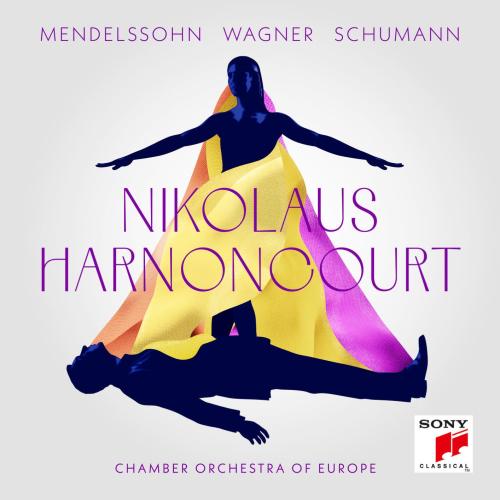
Mendelssohn, Wagner, Schumann Chamber Orchestra Of Europe & Nikolaus Harnoncourt
Album info
Album-Release:
2026
HRA-Release:
27.02.2026
Label: Sony Classical
Genre: Classical
Subgenre: Orchestral
Artist: Chamber Orchestra Of Europe & Nikolaus Harnoncourt
Composer: Richard Wagner (1813-1883), Felix Mendelssohn Bartholdy (1809-1847), Robert Schumann (1810-1856)
Album including Album cover Booklet (PDF)
I`m sorry!
Dear HIGHRESAUDIO Visitor,
due to territorial constraints and also different releases dates in each country you currently can`t purchase this album. We are updating our release dates twice a week. So, please feel free to check from time-to-time, if the album is available for your country.
We suggest, that you bookmark the album and use our Short List function.
Thank you for your understanding and patience.
Yours sincerely, HIGHRESAUDIO
- Felix Mendelssohn-Bartholdy (1809 - 1847): Die schöne Melusine Overture, Op. 32:
- 1 Mendelssohn-Bartholdy: Die schöne Melusine Overture, Op. 32 11:44
- 2 Commentary on Wagner's Tannhäuser by Nikolaus Harnoncourt 00:45
- Richard Wagner (1813 - 1883): Tannhäuser, WWV 70:
- 3 Wagner: Tannhäuser, WWV 70: Overture - Bacchanale (Venusberg) 19:21
- 4 Commentary on Wagner's Tristan und Isolde by Nikolaus Harnoncourt 01:54
- Richard Wagner: Tristan und Isolde, WWV 90: Act I:
- 5 Wagner: Tristan und Isolde, WWV 90: Act I: Prelude 11:24
- 6 Wagner: Tristan und Isolde, WWV 90: Act III: Mild und leise "Isoldes Liebestod" 06:43
- Robert Schumann (1810 - 1856): Requiem für Mignon, Op. 98 b:
- 7 Schumann: Requiem für Mignon, Op. 98 b 11:24
- 8 Commentary on Mendelssohn's Melusine Concert Overture by Nikolaus Harnoncourt and complete performance 18:43
Info for Mendelssohn, Wagner, Schumann
For many, he was the most influential conductor of recent decades: Nikolaus Harnoncourt, also a cellist, founder of Concentus Musicus Wien (with his wife Alice) and the pioneer of early music par excellence. March marks the tenth anniversary of his death. To mark this occasion, a unique concert recording featuring works by Felix Mendelssohn, Robert Schumann and – as a sensational rarity – Richard Wagner will be released on 27 February.
To mark the tenth anniversary of Nikolaus Harnoncourt's death, Sony Classical is releasing a unique concert recording featuring works by Felix Mendelssohn, Robert Schumann and – as a sensational rarity – Richard Wagner.
It is no longer common for previously unreleased recordings to emerge from the estate of an important conductor – especially in the case of an artist as well documented on disc as Nikolaus Harnoncourt. And so it comes as something of a sensation that the ORF recording made during the Styriarte 1999 also features three works that were previously not to be found in the discography of the Austrian conductor, whose tenth anniversary of his death falls on 5 March: In addition to Robert Schumann's enigmatic ‘Requiem for Mignon’, these are excerpts from the Wagner operas “Tannhäuser” and ‘Tristan und Isolde’, which Harnoncourt had included in the programme of his concerts entitled ‘Isoldes Liebestod’ (Isolde's Love Death) together with the overture ‘Die schöne Melusine’ (The Beautiful Melusine) by Felix Mendelssohn Bartholdy.
Harnoncourt, who did not consider himself a Wagner interpreter, took the overarching theme of ‘love’ at the 1999 Styriarte as an opportunity to engage with Richard Wagner's music for the first (and only) time as a conductor. Although much of Wagner's work can be subsumed under the theme of ‘love’, the opera “Tannhäuser” and the music drama ‘Tristan und Isolde’ are exemplary in their own right, so it was logical to choose concert versions of these works for Harnoncourt's only attempt at Wagner. The programme includes the Tannhäuser overture and the Venusberg music, as well as the prelude to Tristan and Liebestod with Violeta Urmana as soloist. Following his own dramaturgy, Harnoncourt framed his foray into Wagner with two works by composers who, beyond the thematic connection between the works, have close but also ambivalent references to Wagner: Felix Mendelssohn Bartholdy and Robert Schumann.
It is a particular pleasure to be able to listen to this recording made by Austrian Radio on 23 June 1999, not only to hear Nikolaus Harnoncourt's live commentary, but also, thanks to the Harnoncourt Archive at the Anton Bruckner Private University in Linz, to gain an insight into Harnoncourt's conducting scores and accompanying notes, thus enabling us to delve even deeper into the conductor's world of ideas. The corresponding QR codes can be found in the text accompanying each work in the booklet accompanying this edition.
Sony Classical had been closely associated with Nikolaus Harnoncourt since the mid-2000s – their collaboration included over 60 CDs and several DVDs covering a broad repertoire from Bach to Bartók. The last project he conducted, Ludwig van Beethoven's monumental ‘Missa solemnis’, was released as his final recording – edited according to Harnoncourt's instructions – as a posthumous legacy in the year of his death, 2016. With the album ‘Mendelssohn – Wagner – Schumann’, Sony Classical, together with its partners ORF, Styriarte and the Harnoncourt family, is creating a musical memorial to this important conductor.
Chamber Orchestra of Europe
Nikolaus Harnoncourt, conductor
Chamber Orchestra Of Europe
Acknowledged as “the finest chamber orchestra in the world” (BBC 2 Television), the Chamber Orchestra of Europe was founded in 1981 by a group of young musicians graduating from the European Union Youth Orchestra. It was their ambition to continue working together at the highest possible professional level, and of that original group, thirteen remain in the current core membership of around sixty. The members of the COE, selected by the Orchestra itself, pursue parallel careers as international soloists, Leaders and Principals of nationally-based orchestras, as members of eminent chamber groups, and as tutors and professors of music. It is their wealth of cultural backgrounds and shared love of music- making which remain at the heart of their inspired performances.
The COE performs in some of the most prominent cultural venues in Europe including the Philharmonie in Paris, the Concertgebouw in Amsterdam, the Baden-Baden Festspielhaus, the Cologne Philharmonie and the Alte Oper in Frankfurt. Together with other major European concert halls, these venues provide a regular touring base for the Orchestra. The COE has a close association with the Lucerne Festival, the Styriarte in Graz and with many of the world’s most prestigious musical events, such as the BBC Proms in London, the Edinburgh International Festival and the Mostly Mozart Festival in New York.
Over the years, the Chamber Orchestra of Europe has developed especially close relationships with the late Claudio Abbado, Bernard Haitink, Nikolaus Harnoncourt, Vladimir Jurowski, Yannick Nézet-Séguin and Sir András Schiff. The Orchestra also performs with many of the world’s most renowned soloists and conductors including, this season, Piotr Anderszewski, Kristian Bezuidenhout, Renaud Capuçon, Alina Ibragimova, Sir Roger Norrington, Francesco Piemontesi, Jean-Guihen Queyras, Christian Tetzlaff, Nobuyuki Tsujii and Robin Ticciati.
In only thirty-five years, the Chamber Orchestra of Europe has recorded over 250 works with all the major recording companies. It has won numerous international prizes for its recordings including three Gramophone Record of the Year awards - for Rossini’s opera Viaggio à Reims, Schubert’s symphonies conducted by Claudio Abbado, and Beethoven’s symphonies conducted by Nikolaus Harnoncourt. The Orchestra has also won two Grammys and the MIDEM “Classical Download” Award. The COE was the first Orchestra to create its own label, “COE Records”, in association with Sanctuary Records, a division of Universal Music. Recent CDs released by the Orchestra include Mozart’s Clarinet Concerto and Quintet with the COE’s principal clarinet Romain Guyot for the label Mirare and Mozart’s Cosi Fan Tutte with Yannick Nézet-Séguin, Rolando Villazon, Mojca Erdmann, Miah Persson, Angela Brower, Adam Plachetka, Alessandro Corbelli, recorded for Deutsche Grammophon and released in 2013. In March 2014, the COE released two CDs: all of the Schumann Symphonies with Yannick Nézet-Séguin for Deutsche Grammophon and works by Bach and Vasks with Renaud Capuçon for EMI. The COE released its recording of Mozart’s Entführung aus dem Serail in July 2015 with Yannick Nézet-Séguin, nominated for a Grammy Award for Best Opera Recording. In 2016, Deutsche Grammophon released the COE’s recording of Mozart’s Marriage of Figaro, with Yannick Nézet-Séguin – also nominated for a Grammy Award for Best Opera Recording 2017; then ECM Records released our recording of the Schumann and Mendelssohn Violin Concertos with Carolin Widmann, recorded at the Baden-Baden Festspielhaus. Future planned CD projects include all of the Mendelssohn symphonies, recorded at the Paris Philharmonie with Yannick Nézet-Séguin in February 2016, also for Deutsche Grammophon.
In recent years, the COE has released a number of DVDs and in particular has developed a close association with producing companies Idéale Audience and Styriarte/ORF. Idéale Audience produced two DVDs of concerts performed at the Cité de la musique in Paris, namely Ravel’s Piano Concerto in G, R. Strauss’s Metamorphosen and Bourgeois Gentilhomme Suite conducted by Vladimir Jurowski with Hélène Grimaud and Sibelius’s Rakastava, Valse Triste and Violin Concerto and Schumann’s Symphony No. 1 conducted by Vladimir Ashkenazy with Ukrainian violinist Valeriy Sokolov. Further DVD releases with Idéale Audience include Beethoven’s Missa Solemnis with John Nelson and the Gulbenkian Choir, filmed at Lisbon’s Gulbenkian Foundation in 2010. The Styriarte, in association with the ORF (Austria’s Radio and Television network), released three DVDs of the COE’s performances at the Styriarte Festival, Beethoven’s Mass in C and Symphony No. 5 (2007) and Smetana’s Má Vlast (2010) and The Bartered Bride (2011). All of the COE’s recordings can be purchased on Amazon or downloaded from iTunes and Spotify.
To enable young people and new audiences to experience at first hand high quality live orchestral and chamber music, the COE has an active education and outreach programme designed for school, conservatoire and concert hall. The COE Academy was created in 2009 and each year awards full scholarships to exceptionally talented postgraduate students and young professionals to study with the COE’s principal players when the Orchestra is ‘on tour’.
The COE receives invaluable financial support from a number of Friends including particularly The Gatsby Charitable Foundation, without which it could not survive. The Leader Chair is supported by Dasha Shenkman. The Principal Cello Chair is supported by an anonymous donor. The Principal Bass Chair is supported by Sir Siegmund Warburg’s Voluntary Settlement. The Principal Oboe Chair and the Principal Flute Chair are supported by the Rupert Hughes Will Trust in memory of the late Rupert Hughes. The Principal Trumpet Chair is supported by The Underwood Trust.
Nikolaus Harnoncourt
Born in Berlin, the Austrian conductor Nikolaus Harnoncourt spent his childhood and youth in Graz, where he grew up in the Meran Palace. His father was a scion of the de la Fontaine-d’Harnoncourt-Unverzagt family, Counts of Luxembourg and Lorraine, his mother the great-granddaughter of Archduke Johann of Styria.Heeding his early artistic ambition, he ultimately preferred to study cello at the Vienna Academy of Music. He joined the Vienna Symphony Orchestra as a cellist in 1952. A year later he founded the Concentus Musicus Wien together with his wife Alice, to provide a forum for his increasingly intensive work with period instruments and Renaissance and baroque musical performance tradition.
Nikolaus Harnoncourt collected historical instruments and, in addition to his performing and conducting activities, devoted his time to his philosophical analyses of “Musik als Klangrede” (“music as speech”), which have to date remained the seminal works on the performance of early music, the key to an entire universe of forgotten works and musical experiences buried under the sands of time.
From 1972 Nikolaus Harnoncourt taught performance practice and the study of historical instruments at the Mozarteum University of Music and Dramatic Arts in Salzburg, while at the same time enjoying growing success as an opera conductor. His debut at the Theater an der Wien with Monteverdi’s “Il ritorno d’Ulisse in patria” in 1971 was followed by the now legendary cycle of Monteverdi operas, which he developed in collaboration with Jean-Pierre Ponnelle, director at the Zurich Opera House, and which was universally acclaimed as a sensational breakthrough. This cycle was followed by an equally exemplary and ground-breaking cycle of Mozart operas, again at the Zurich Opera House and again in partnership with Ponnelle. Nikolaus Harnoncourt’s career as a conductor of both orchestral works and opera encompasses Viennese Classicism, the Romantic repertoire and works from the 20th century. Some milestones are a Mozart cycle at the Vienna State Opera, the Salzburg Festival with mit Monteverdi’s “L’incoronazione di Poppea” and Mozar’s “Le nozze di Figaro”, “Don Giovanni” and “La clemenza di Tito”. In between, he repeatedly returned to Zurich with Weber’s “Freischütz”, Schubert’s “Des Teufels Lustschloss” and “Alfonso und Estrella”, Offenbach’s “La belle Hélène”, “La Périchole” and “La Grande-Duchesse de Gérolstein”, or Verdis “Aida”. With the Concertgebouw Orchestra of Amsterdam, the Chamber Orchestra of Europe, and the Vienna and Berlin Philharmonic Orchestras, Nikolaus Harnoncourt constantly reinterpreted and rediscovered the grand repertoire of orchestral works: the concertos and symphonies of Haydn and Mozart, Beethoven, Mendelssohn, Schubert, Schumann, Brahms, Dvorák and Bruckner, but also the works of Bela Bartók and Alban Berg.
A central venue for many of these projects has been the styriarte Festival, founded in 1985 to establish a closer link between Nikolaus Harnoncourt and his home city of Graz. This is also where he first conducted Schuman’s “Genoveva”, the Prelude and Liebestod from Wagner’s “Tristan and Isolde” and, in 2001, Verdi’s “Requiem”. In 2003 these were followed by the first scenic production of an opera with Offenbach’s “La Grande-Duchesse de Gérolstein” and by Bizet’s “Carmen” in the year 2005. In 2008 Nikolaus Harnoncourt not only conducted but also directed an opera in Graz: Mozart’s “Idomeneo”, which was highly acclaimed by national and international media (“once-in-a-hundred-years event”, Frankfurter Rundschau). In 2009, he proved to even have “the blues running through his veins” (Die Welt) with a highly acclaimed production of Gershwin’s “Porgy and Bess”, in 2011 he conducted in Graz a sensational production of “The Bartered Bride” (Smetana), followed by Offenbach’s “Barbe-Bleue (Bluebeard)” in 2013. And 2014 he traced back to baroque music as he brillantly realised a scenic production of Purcell’s “The Fairy Queen”. Nikolaus Harnoncourt will always be one of the few true stars among conductors worldwide. Performances like the New Year’s Concert of the Vienna Philharmonic Orchestra (2001, 2003) enabled him to reach an audience of millions, displaying the characteristic passion and fiery intensity that identify him, first and foremost, as a true servant of his art.
On December 5th, 2015 Nikolaus Harnoncourt informed his audience in an open letter that he will immediately retire from stage. Only three months later, on March 5th, 2016, he died, surrounded by his family, at the house at Attersee.
Booklet for Mendelssohn, Wagner, Schumann