







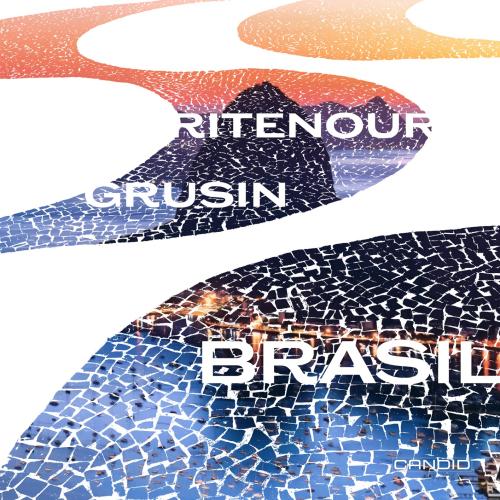
Brasil Lee Ritenour & Dave Grusin
Album info
Album-Release:
2024
HRA-Release:
04.03.2026
Album including Album cover
- 1 Cravo E Canela (Cloves & Cinnamon) 04:04
- 2 For the Palms 03:36
- 3 Catavento 03:20
- 4 Vitoriosa (Victorious) 04:49
- 5 Meu Samba Torto (My Crooked Samba) 05:48
- 6 Stone Flower 07:06
- 7 Boca De Siri (Keep It Quiet) 04:04
- 8 Lil Rock Way 05:13
- 9 Canto Invierno (Winter Song) 03:51
Info for Brasil
BRASIL, the new album by Lee Ritenour and Dave Grusin is a showcase for the unique talents of two of the most successful and influential musicians of their generation. It has been an enduring friendship and collaboration, from playing the famed Baked Potato in Los Angeles in the 70s, to collaborations on Dave’s records and films and Lee’s albums, plus years of touring together on the biggest stages.
Guitarist Ritenour and pianist Grusin began their fervent involvement in Brazilian music half a century ago. And, as boldly demonstrated on BRASIL, their new studio recording in several decades dedicated to the genre, their passion remains unabated. BRASIL is a bracing survey of contemporary Brazilian sounds featuring some of that country’s most notable young musicians. Also spotlighted are the talents of Swiss born harmonica ace Grégoire Maret and Brazilian vocalist and composer Ivan Lins, whose album Harlequin with Ritenour and Grusin won a GRAMMY® Award in 1986.
The genesis of BRASIL came about quite organically. Lee’s Brazilian wife Carmen counts among her ongoing acquaintances the late Antonio Carlos Jobim’s wife Ana. Their son Wesley, a much in demand drummer, has also spent considerable time in the Brazilian music scene. “Through Wesley’s contacts and input from friend and renowned guitarist Chico Pinheiro, I became aware of the many great musicians currently active there. So, I talked to Dave about going to Brazil to do a recording,” states Lee. “There were always great musicians but now there were also great studio players who could bend their style and contribute the way we used to as studio musicians in the early days of our careers. We would be challenged but also comfortable in playing with the Brazilian musicians we had invited to play on the recording.”
Dave readily agreed to participate. “It’s almost like being part of a family,” he reflects. “It was such a life saver when I first got involved in the Brazilian music scene and so much fun to get back into it, especially with these players. The inherent Brazilian attitude in their playing reminded me things had not changed that much over the years. We were the two gringos thrown into their world and that’s the dynamic we wanted to happen.”
The core Brazilian contingent handpicked to anchor the rhythm section were drummer Edu Ribeiro, bassist Bruno Migotto, and percussionist Marcelo Costa. Vocalist Tatiana Parra is featured on three tracks and how she became involved says much about how the album was put together. “She is a studio singer who could instantly wrap herself around what we needed,” Dave explains. “She’s just amazing,” Lee adds.
The session is notable for inclusion of two songs by singer and composer Milton Nascimento. “The albums Milton did in the late ‘60s and early ‘70s influenced me greatly,” Lee comments, referencing the two classics featured, “Cravo e Canela” and “Catavento.” The choice of these tunes, the guitarist explains, was not based on who the composer was but what the song itself would bring to the program.
Lee’s composition “For the Palms,” a meditative ballad, was written in reflection to the 2018 Woolsey Fire that destroyed his Malibu home. Several majestic palm trees had to be removed due to construction guidelines. “My wife was very distraught, and I composed this tune in response. It didn’t have anything to do with Brazil, but rather with the Brazilian in my life.”
The album also showcases Swiss-born harmonica master Grégoire Maret on three tracks. “He has been handed the crown Toots Thielemans, the harmonica legend, left when he passed,” Dave states, noting the role Thielemans played in bringing the harmonica into the jazz mainstream.“
The artistry of longtime collaborator singer and composer Ivan Lins is celebrated on “Victoriosa,” a gorgeous ballad featuring Tatiana Parra in a supportive vocal role. “When Dave and I did Harlequin in 1985, featuring some of Ivan’s hits, I had gone to Brazil, and started to notice all these great tunes. Ivan had just taken off and walking around the streets of Rio and São Paulo you would hear a veritable soundtrack that in many cases was Ivan’s music. I suggested to Dave we should do an album of his music, and Harlequin was the result. We could have done dozens of his songs on this recording but went with just one we thought we could make our own. It ended up being a magical combination with Dave, myself, Ivan and Tatiana.”
With so many compelling Jobim compositions that could have been chosen “Stone Flower” was the perfect choice. The tune’s surging rhythms and haunting melody are truly spellbinding. “We’ve been playing it live for years,” Lee comments, “and recorded it on the 1997 album A Twist of Jobim.” Chico Pinheiro and Lee share the solo duties, producing joyous results. “It might be Jobim’s most progressive composition that’s become popular with jazz musicians, and it was great to do it with this Brazilian rhythm section and have that authentic feel,” Lee adds.
“When I first heard composer, singer, and guitarist Celso Fonseca’s “Meu Samba Torto” I fell in love with it,” states Lee. “I knew it would be a great vehicle for us along with Celso. It’s a very hypnotic song we had to weave our way into, instead of the other way around, and it turned out great!” Dave adds, “The tune was very interesting, in a sense he’s like a holdover to the tradition of Brazilian music – bossa nova – that we’ve never let go of.”
Closing out the set Lee is reunited with fellow guitarist Chico Pinheiro who penned the rhythmically slinky “Boca de Siri,” Grégoire Maret’s harmonica gets another turn on Ritenour’s “Lil’ Rock Way” and Dave’s regal “Canto Invierno” concludes it on an elegant note.
Ritenour and Grusin have made an indelible mark in the music industry. With the release of BRASIL, they continue to exemplify how their longevity and success is tribute to their ability to stay on the pulse of the music scene today. “Brazilian music continues to permeate the world,” Lee observes. “So, now was the right time and inspiration to go to Brazil and do this recording.” And their musical magic continues!
Lee Ritenour,guitar
Dave Grusin, piano, keyboards
Celso Fonseca, guitar, vocals
Tatiana Parra, vocals
Ivan Lins, vocals
Chico Pinheiro, guitar, vocals
Gregoire Maret, harmonica
Bruno Migotto, bass
Edu Ribiero, drums
Produced by Lee Ritenour & Dave Grusin
Executive producer Michael Lizárraga
Recorded in São Paulo, Brazil & Los Angeles, Calif, 2023

Lee Ritenour
Starting at the age of 16, Lee played his first session with The Mama's and the Papa's. Two years later he was backing Tony Bennett and Lena Horne at L.A.'s Dorothy Chandler Pavilion. Known as "Captain Fingers," Ritenour became a sought-after session player in the mid-70's. Starting in 1976, at the age of 24, he began his own solo career which now includes over 30 albums and collaborations. Although heavily influenced in his early days by the relaxed styles of Wes Montgomery, Joe Pass and Barney Kessel, he now has his own distinctive sound and fluid style. His list of session work is awesome (some 3,000 sessions), but some of his notable performances were with Herbie Hancock, Steely Dan, Dizzy Gillespie, Sonny Rollins and Pink Floyd. Since the mid-80's Ritenour has been strongly influenced by Brazilian music.
Along the way, Ritenour has received 17 Grammy nominations, earned several gold albums, numerous #1 spots in guitar polls and the prestigious "Alumnus of the Year" award from USC. In 1981, he scored the pop15 hit "Is It You," featuring vocalist Eric Tagg, which has also become a smooth jazz radio classic. He joined GRP Records in 1985 after recording for Electra the previous 7 years. At that time, he recorded the magnificent Harlequin album with GRP co-owner Dave Grusin. It was nominated for four Grammys and won one that year.
In the early 90's, Ritenour teamed up with Bob James, Harvey Mason and bass player Nathan East under the name of Fourplay, who has released a number of soul/jazz/funk fusion albums for Warner Brothers Records. Lee was a founding member of the original band and participated in the first three releases which remain their biggest hits to date. The first Fourplay album in 1991 spent an unprecedented 33 weeks at No. 1 on Billboard's contemporary jazz chart.
In 1993, Ritenour topped the Billboard jazz chart with his accomplished tribute to Wes Montgomery on his album Wes Bound, and followed it in 1995 with an excellent joint album with Larry Carlton. In 1997, Ritenour was a founding partner of i.e. Music at Polygram Records. The first release on i.e. Music was a Twist of Jobim paying tribute to the great Brazilian composer Antonio Carlos Jobim. The single "Water to Drink" from this album was a #1 Radio N Records NAC airplay single in 1997. In 2000, he and Dave Grusin returned to their classical roots with Two Worlds, which remained on Billboard's classical charts for 51 weeks. In 2001 he released the second of the Twist of trilogy, with a tribute to Bob Marley, placing reggae classics in a contemporary setting. The first single "Get Up, Stand Up," was the #1 Radio N Records NAC airplay single of 2001. In 2002, Ritenour released Rit's House, a jazzier, funk album with many new original compositions of Ritenour's. The final of the Twist of trilogy was the 2003 release A Twist of Motown.
Dave Grusin
Robert David Grusin (b. 1934) is an American composer, arranger, producer, and pianist. He has composed many scores for feature films and television, and has won numerous awards for his soundtrack and record work, including an Academy Award and ten Grammy Awards.
Grusin was born in Littleton, Colorado, to Henri and Rosabelle (née de Poyster) Grusin. His mother was a pianist and his father was a violinist from Riga, Latvia. He studied music at the University of Colorado at Boulder and was awarded his degree in 1956. His teachers included Cecil Effinger and Wayne Scott, pianist, arranger and professor of jazz.
Grusin produced his first single in 1962, Subways Are for Sleeping, and his first film score, for Divorce American Style, in 1967. Other scores followed, including The Graduate (1967), Winning (1969), The Friends of Eddie Coyle (1973), The Midnight Man (1974), and Three Days of the Condor (1975).
In 1978, he founded GRP Records with his business partner, Larry Rosen, and began to produce some of the first commercial digital recordings. He was the composer for On Golden Pond (1981), Tootsie (1982), and The Goonies (1985). In 1988, he won the Oscar for best original score, for The Milagro Beanfield War. He composed the musical signatures for the 1984 TriStar Pictures logo and the 1993 Columbia Pictures Television logo. Grusin has a filmography of about 100 titles.
From 2000-11, Grusin concentrated on composing classical and jazz compositions, touring and recording with collaborators, including jazz singer and lyricist Lorraine Feather and guitarist Lee Ritenour. Their album Harlequin won a Grammy Award in 1985. Their classical crossover albums, Two Worlds and Amparo, were nominated for Grammys.
Grusin received honorary doctorates from Berklee College of Music in 1988 and University of Colorado, College of Music in 1989.
This album contains no booklet.