


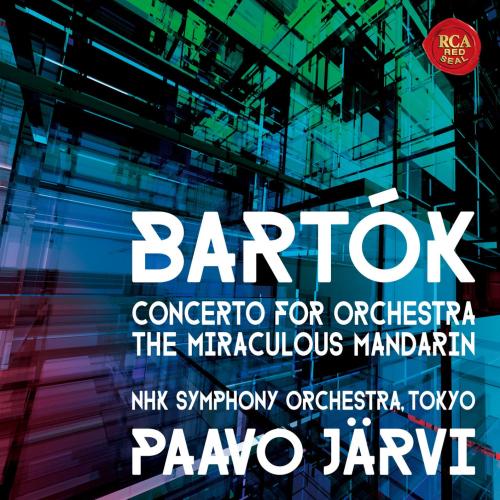
Bartok: Concerto for Orchestra / The Miraculous Mandarin Suite NHK Symphony Orchestra, Tokyo & Paavo Järvi
Album info
Album-Release:
2023
HRA-Release:
12.04.2023
Label: Sony Music Labels Inc.
Genre: Classical
Subgenre: Concertos
Artist: NHK Symphony Orchestra, Tokyo & Paavo Järvi
Composer: Béla Bartok (1881-1945)
Album including Album cover
I`m sorry!
Dear HIGHRESAUDIO Visitor,
due to territorial constraints and also different releases dates in each country you currently can`t purchase this album. We are updating our release dates twice a week. So, please feel free to check from time-to-time, if the album is available for your country.
We suggest, that you bookmark the album and use our Short List function.
Thank you for your understanding and patience.
Yours sincerely, HIGHRESAUDIO
- Béla Bartók (1881 - 1945): The Miraculous Mandarin Suite, Op. 19, BB 82 / Sz 73 I. Introduction (street noises). The command of the hoodlums directed at the girl.:
- 1 Bartók: The Miraculous Mandarin Suite, Op. 19, BB 82 / Sz 73 I. Introduction (street noises). The command of the hoodlums directed at the girl. 02:38
- The Miraculous Mandarin Suite, Op. 19, BB 82 / Sz 73 II. The girl's first inviting gestures (clarinet solo), in response to which the old gentleman appears, who gets thrown out in the end by th.:
- 2 Bartók: The Miraculous Mandarin Suite, Op. 19, BB 82 / Sz 73 II. The girl's first inviting gestures (clarinet solo), in response to which the old gentleman appears, who gets thrown out in the end by the hoodlums. 03:43
- The Miraculous Mandarin Suite, Op. 19, BB 82 / Sz 73 III. The girl's second inviting gestures, upon which appears the young lad, who is also thrown out.:
- 3 Bartók: The Miraculous Mandarin Suite, Op. 19, BB 82 / Sz 73 III. The girl's second inviting gestures, upon which appears the young lad, who is also thrown out. 03:22
- The Miraculous Mandarin Suite, Op. 19, BB 82 / Sz 73 IV. The girl's third inviting gestures. The mandarin appears (tutti ff).ird decoy game.:
- 4 Bartók: The Miraculous Mandarin Suite, Op. 19, BB 82 / Sz 73 IV. The girl's third inviting gestures. The mandarin appears (tutti ff).ird decoy game. 02:34
- The Miraculous Mandarin Suite, Op. 19, BB 82 / Sz 73 V. The girl's seductive dance before the mandarin (at first slow, then increasingly faster Waltz).:
- 5 Bartók: The Miraculous Mandarin Suite, Op. 19, BB 82 / Sz 73 V. The girl's seductive dance before the mandarin (at first slow, then increasingly faster Waltz). 04:56
- The Miraculous Mandarin Suite, Op. 19, BB 82 / Sz 73 VI. The mandarin catches up with the girl after an ever wilder chase.:
- 6 Bartók: The Miraculous Mandarin Suite, Op. 19, BB 82 / Sz 73 VI. The mandarin catches up with the girl after an ever wilder chase. 02:06
- Concerto for Orchestra, BB 123 / Sz 116 I. Introduzione:
- 7 Bartók: Concerto for Orchestra, BB 123 / Sz 116 I. Introduzione 10:04
- Concerto for Orchestra, BB 123 / Sz 116 II. Gioco delle coppie:
- 8 Bartók: Concerto for Orchestra, BB 123 / Sz 116 II. Gioco delle coppie 06:41
- Concerto for Orchestra, BB 123 / Sz 116 III. Elegia:
- 9 Bartók: Concerto for Orchestra, BB 123 / Sz 116 III. Elegia 07:45
- Concerto for Orchestra, BB 123 / Sz 116 IV. Intermezzo interrotto:
- 10 Bartók: Concerto for Orchestra, BB 123 / Sz 116 IV. Intermezzo interrotto 04:18
- Concerto for Orchestra, BB 123 / Sz 116 V. Finale:
- 11 Bartók: Concerto for Orchestra, BB 123 / Sz 116 V. Finale 09:36
Info for Bartok: Concerto for Orchestra / The Miraculous Mandarin Suite
Masterpieces of the 20th Century: The final album of Paavo Järvi and the NHK Symphony Orchestra... Two masterpieces of Bartók's music.
The Bartók album that marked the end of an era for Paavo Järvi and the NHK Symphony Orchestra is now available. It is a live recording of the Bartók Pro, which he fully committed to in his final season as principal conductor, and is the counterpart to the Trilogy consisting of "Strings, Chere," "Divertimento," and "Dance Suite," released in 2019.
Järvi's first recording, "The Wonderful Chinese Officials," uses a suite version and is a terrific performance that synergizes the high virtuosity of the NHK Symphony Orchestra with Järvi's close drive. The concerto for orchestra is Järvi's first re-recording in 16 years, but this is a reprise of a popular work that was selected as one of the "Top 10 Concerts" when Järvi became chief conductor of the NHK Symphony Orchestra, and it is a fulfilling performance that clearly reflects the fruits and weight of the musical activities accumulated by this duo. Here is a new Bartók sound world, deeply marked by Järvi's achievement of combining and developing the German sound and high functionality of the N Symphony Orchestra.
Paavo Järvi discusses two of Bartók's orchestral masterpieces:
The Mysterious Chinese Official was written between 1918 and 1924. I believe that an essential part of the work has a special relationship to this period. After the end of World War I, composers were reluctant to paint a brush with music that celebrated deep emotion and affection. The war that had just ended was too brutal and inhuman. Art that had been conceived in terms of beauty, warmth, and loveliness was felt to be inappropriate. The resulting music tended toward dynamic elements, sometimes rough and mechanical (the description often given to such works is "primitivism," as in Stravinsky's "Rite of Spring"). Despite its exquisite formatting, skillful orchestration, and colorful instrumentation, "The Wonderful Chinese Official" is a work that deliberately refuses to be refined. I am fascinated by the savagery and gruesome character of Bartók's blend of radicalism and thoroughgoing barbarism.
Few orchestral works written in the middle of the 20th century have gained the same level of recognition as the Concerto for Orchestra. It is possible that Bartók's writing was motivated by a desire for wide public acceptance, a product of his period of severe economic hardship. While he wrote music of little complexity, perhaps systematically, I believe that the means of expression he employed show a degree of deepening. He made the highly intricate material accessible to his audience by adding his own touches. Like the relatively well-known Piano Concerto No. 3, the "Concerto for Orchestra" has an element of simplification that, in my opinion, even enhances its greatness. This process of deepening seems to have been followed by many composers, such as Prokofiev, Shostakovich, and Mahler (especially the 9th Symphony), to name a few. They all reached this state at the end of their lives. Their musical vocabulary has all become simpler, more transparent and direct, and though contradictory in form, they say more while being less complex.
This album is the second Bartók album by myself and the NHK Symphony Orchestra. The works on this disc are all as demanding as solo concertos in terms of difficult passages for all instruments, but the individual musicians and sections are superb, and the orchestra as a whole is at its best. I hope listeners will enjoy what we have accomplished." (Translated by Issei Kiba, from the manufacturer's materials)
NHK Symphony Orchestra
Paavo Järvi, conductor
No biography found.
This album contains no booklet.