


The Ark Anthony Joseph
Album info
Album-Release:
2026
HRA-Release:
24.04.2026
Album including Album cover
- 1 James 07:13
- 2 Blue Susan 04:55
- 3 Transposition of Space (Glissant) 07:56
- 4 The African Origins of UFOs 05:12
- 5 The Ark 08:47
- 6 Your Bird & I 04:19
- 7 Baron Samedi 11:16
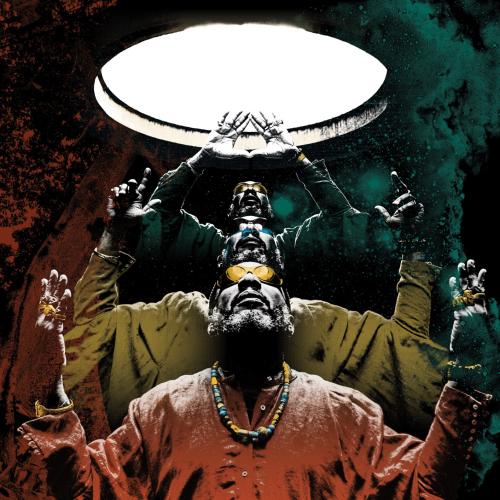
Info for The Ark
Time To Get On Board A New Black Universal Express. With each new recording Anthony Joseph presents an imaginative, personal vision of contemporary black culture, and The Ark is yet another compelling album by the award-winning Trinidadian poet and musician. This second part of a sequence of two albums launched with last year’s Rowing Up River To Get Our Names Back, finds Joseph giving full vent to his desire to explore many thought-provoking themes. However, there is a specific thread running through the glorious offering of sounds.
”I was especially interested in the idea of using Afrofuturism as a means of using the future in order to correct the wrongs of the past,” explains Joseph. “And so a lot of lyrics reimage or imagine an alternate black history. At the same time there are elements of autobiography.” The aforesaid cultural phenomenon, a view of the black experience through the prism of science fiction and ancient Egypt and Africa, as mapped out by visionaries from music and literature such as Sun Ra, Parliament-Funkadelic and Octavia E. Butler, has previously inspired Joseph. His 2006 novel The African Origins Of UFOs was a multi-hued work, and the new music shows how Joseph has, much like all significant artists, gone on to broaden his conceptual palette, creating beguiling new stories and images set to startling rhythms and tones. Tracks such as ‘James’, with its taut, crisp bass and dubbed-up brass, and ‘Transposition Of Space (Glissant)’, a potent evocation of the influential Martiniquan theorist set in a haze of jazz guitar and ambient synthesizers, are marvels of text-sound painting. As for ‘Baron Samedi’, shaped by a languid, almost wounded guitar line and slow rise of horns that frame Joseph’s journey to the ‘mountain of fire, almost touching the sky’ it is an epic blend of commanding vocal delivery and dramatic sonic tapestry.
Joseph led the Spasm band in the early 2000s and recorded well-received albums such as Bird Head Son and Time, in which songs were largely based on spirituals or chants enhanced by improvisation. But his musical curiosity has naturally led to collaborations, and the new work is produced by Dave Okumu, the prodigiously talented guitarist-vocalist-composer known as the leader of Mercury Music Prize-nominated The Invisible, and who was also a member of the seminal band Jade Fox.
Having first performed together at a show curated by influential saxophonist-flautist Shabaka Hutchings at the storied Total Refreshment Centre In London during lockdown, Joseph and Okumu struck up a rapport that further developed when the former guested on he latter’s album. With the connection made Joseph knew Okumu was the ideal producer for this latest project, which has a freewheeling, almost black psychedelic thing. After sifting through demos and loops the guitarist made on pro-tools the poet started to live with the music. Many months later words began to take shape. Joseph then went into the studio with Okumu’s band and set about creating a magnum opus. Boasting a stellar cast such as vocalist Eska Mtungwazi, trumpeter Byron Wallen and keyboardist Nick Ramm, The Ark is a highly intricate musical mosaic framed by simmering funk grooves, wily jazz improvisation and haunting dub effects. Through the use of many genres the music has simply become its own genre.
The Ark can be perceived as a vessel or means of transport to new worlds, along the lines of Sun Ra’s Ark or Funkadelic’s Mothership, and the material it contains is a unique blend of who Anthony Joseph is and how he sees the world and society in these stimulating, challenging times. “It balances the personal with the universal in a much more vulnerable, accessible way than on previous albums,” Joseph explains. “It has become less about a personal experience and more about a collective, communal experience in which the artist is conduit, messenger, urban griot.”
Dave Okumu, guitars, bass, programming, percussion
Eska Mtungwazi, vocals, vocal arrangement
Tom Skinner, drums
Byron Wallen, trumpet
Nick Ramm, keyboard
Colin Webster, saxophone
Aviram Barath, Fender Rhodes, synthesisers
Dan See, drums
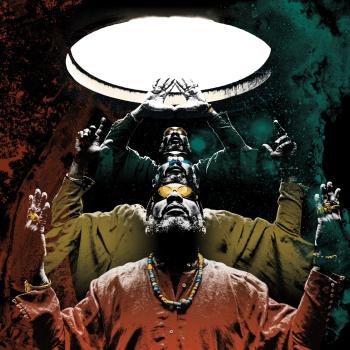
Anthony Joseph
is a poet, novelist, academic and musician who moved from Trinidad to the UK in 1989. A lecturer in creative writing at Birkbeck College, he is particularly interested in the point at which poetry becomes music.
As well as four poetry collections, a slew of albums, and three novels – most recently Kitch – Joseph has published critical work exploring the aesthetics of Caribbean Poetry among other subjects. He performs internationally as the lead vocalist for his band The Spasm Band. Sonnets for Albert is his first poetry collection since Rubber Orchestras. His most recent album is The Rich Are Only Defeated When Running for Their Lives.
The life of Caribbean people is not really documented. So this idea of Caribbean life being fragmented is something that I've had in my mind for a long time. So when I came to write this collection for my father, I realized that it was the same process and what I had were fragments, especially with him, because he wasn't around in a physical sense all the time. So all I had were little photographs, scattered memories, and remembrances. They're little parts of his life and parts of my experience with him... I never disliked my father. I always loved him and always was fascinated and captivated by him.
My relationship with improvisational music is something that I'm still trying to theorize and trying to understand exactly why it is that it works. So all I know is that, in approaching a poem, it's about form and content. It's about matching process to content. And for me, the act of writing poetry is kind of like a jazz soloist puts together a solo. It's related in that way because as a writer, as a poet, you are always looking for the new. You're looking for something, a new way of saying something. You're using language that everyone uses, but you're always trying to reuse it in an original way. Always trying to have a phrase or metaphor that is new.
This album contains no booklet.