


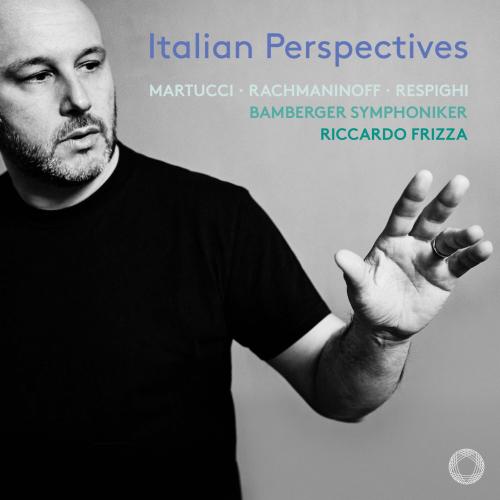
Italian Perspectives Bamberg Symphony & Riccardo Frizza
Album info
Album-Release:
2027
HRA-Release:
06.02.2026
Label: PentaTone
Genre: Classical
Subgenre: Orchestral
Artist: Bamberg Symphony & Riccardo Frizza
Composer: Sergej Rachmaninoff (1873-1943), Ottorino Respighi (1879-1936), Giuseppe Martucci (1856-1909)
Album including Album cover Booklet (PDF)
- Sergei Rachmaninoff (1873 - 1943): 5 Études-tableaux (Arr. for Orchestra by O. Respighi):
- 1 Rachmaninoff: 5 Études-tableaux (Arr. for Orchestra by O. Respighi): No. 1, La Mer et les Mouettes 08:15
- 2 Rachmaninoff: 5 Études-tableaux (Arr. for Orchestra by O. Respighi): No. 2, La Foire 01:52
- 3 Rachmaninoff: 5 Études-tableaux (Arr. for Orchestra by O. Respighi): No. 3, Marche funèbre 06:33
- 4 Rachmaninoff: 5 Études-tableaux (Arr. for Orchestra by O. Respighi): No. 4, Le chaperon rouge et le loup 02:59
- 5 Rachmaninoff: 5 Études-tableaux (Arr. for Orchestra by O. Respighi): No. 5, Marche 03:41
- Ottorino Respighi (1879 - 1936): Trittico Botticelliano:
- 6 Respighi: Trittico Botticelliano: No. 1, La Primavera 05:48
- 7 Respighi: Trittico Botticelliano: No. 2, L'adorazione dei Magi 10:01
- 8 Respighi: Trittico Botticelliano: No. 3, La nascita di Venere 05:30
- Giuseppe Martucci (1856 - 1909): Symphony No. 1 in D Minor, Op. 75:
- 9 Martucci: Symphony No. 1 in D Minor, Op. 75: I. Allegro 11:58
- 10 Martucci: Symphony No. 1 in D Minor, Op. 75: II. Andante 08:07
- 11 Martucci: Symphony No. 1 in D Minor, Op. 75: III. Allegretto 05:28
- 12 Martucci: Symphony No. 1 in D Minor, Op. 75: IV. Mosso - Moderato - Allegro risoluto 13:11
Info for Italian Perspectives
The Bamberger Symphoniker and Riccardo Frizza chart the revival of Italian instrumental music, from Martucci’s Brahmsian yet impassioned Symphony No. 1 to Respighi’s vividly colored orchestral works that animate Renaissance art and transform Rachmaninoff’s Études-Tableaux into richly narrative soundscapes.
“Martucci and Respighi have, for many years in Italy, paid the price of being pigeonholed in a creative style that was judged to be too academic, of being considered ‘different’ in the birthplace of opera and, in Respighi’s case, of remaining ensnared in biographical and political matters (his association with fascism) which have hampered full understanding of his work. It is disheartening for an Italian conductor to see how the rising fortunes of these composers, partly thanks to some of Martucci’s captivating work, are today finding fertile ground mainly outside Italy.
“As a result, it is need rather than fortuitous choice that today brings me to conduct Martucci and Respighi. Martucci’s Symphony No. 1 is modern in mood and rigorous in structure. What fascinates me in Respighi’s orchestration of Rachmaninoff’s 5 Études-tableaux is its dual register, academic and experimental, culminating in the remarkable power of the orchestra’s apotheosis. The Trittico Botticelliano remains a masterpiece of Respighi’s symphonic work, merging orchestral colour and poetic expression in unparalleled perfection.” (Riccardo Frizza)
Bamberger Symphoniker
Riccardo Frizza, conductor
The Bamberg Symphony
is the only orchestra of world renown that is not based in a vibrant metropolis. Almost 10% of the local population subscribe to one of the orchestra's five concert series, in many cases for decades. However, the "magnetic effect" of the orchestra goes above all outward: the traveling orchestra has been carrying its characteristically dark, somber and warm sound and the musical echo of its hometown into the world since 1946. With almost 7,500 concerts in over 500 cities and 63 countries, they have become a cultural ambassador for Bavaria and the whole of Germany. They regularly tour the USA, South America, Japan and China, for example, and are invited by renowned concert halls and festivals worldwide. The Bamberg Symphony therefore describe their mission in short words as Resonating worldwide.
The circumstances of its founding make the Bamberg Symphony a mirror of German history: in 1946, former members of the German Philharmonic Orchestra Prague met colleagues in Bamberg who had also had to flee their homeland as a result of the war and post-war turmoil. Starting with the Prague orchestra, its lines of tradition can be traced back to the 19th and 18th centuries. Thus the roots of the Bamberg Symphony reach back to Mahler and Mozart. Since 2004, the orchestra has held the honorary title of Bavarian State Philharmonic Orchestra and is substantially financed by the Free State of Bavaria.
Four principal conductors, Joseph Keilberth, James Loughran, Horst Stein and Jonathan Nott, as well as Artistic Director Eugen Jochum have led the orchestra since 1946. With the Czech Jakub Hrůša, the fifth principal conductor since 2016, a bridge has been built again between the historical roots of the Bamberg Symphony and its present day, more than 75 years after the orchestra was founded. They regularly perform with their honorary conductors Herbert Blomstedt, Christoph Eschenbach and Manfred Honeck, as well as with other leading conductors such as Andris Nelsons and Lahav Shani.
A not insignificant contribution to the worldwide high profile of the Bamberg Symphony has also been made by countless concert broadcasts in cooperation with the Bavarian Radio (BR) as well as radio, record and CD productions.
Since 2022, the Bamberg Symphony has set itself the goal of acting and traveling in a more climate-friendly manner, e.g., using means of transportation powered by alternative energy sources. For larger tours and trips abroad, efforts are being made to optimize travel routes and tour procedures. Increasingly, the orchestra stays in one country or place for longer periods, e.g., to play residencies or realize educational projects with local artists. By financially supporting environmental projects, including those in concert locations, the orchestra attempts to offset most of the CO2 emissions caused by its travels itself.
Riccardo Frizza
is Musical Director and Artistic Director of the Bergamo Donizetti Opera Festival and Honorary Conductor of the Hungarian Radio Symphony Orchestra and Choir.
A native of Brescia, he trained at the Conservatory of Milan and at the Accademia Chigiana di Siena and is widely regarded as one of today’s leading conductors, regularly collaborating with the world’s most prestigious opera houses.
He is in great demand as a conductor of opera, but also devotes himself with passion, as can be seen from his busy schedule, to the symphonic repertoire, which has taken him to the Accademia Nazionale di Santa Cecilia, Gewandhaus Leipzig, Sächsische Staatskapelle Dresden, Orchestra Sinfonica di Milano, the Mahler Chamber Orchestra, the St. Petersburg Philharmonic Orchestra, London Philharmonia Orchestra, Tonkünstler Orchestra, Euskadiko Orchestra, Tokyo Symphony Orchestra, Orchestra Haydn and Tokyo Philharmonic Orchestra.
From the spring of 2022 to that of 2025, he served as Chief Conductor of the Hungarian Radio Symphony Orchestra and Choir, whose repertoire he is enriching with masterpieces by Richard Strauss and Mahler, but also Italian orchestral works by Martucci and Respighi. His collaboration with the historic Hungarian ensemble continues intensively, both in Budapest and on tour, as well as in recordings. Their first CD, released in spring 2024, consists of the Requiem and Stabat mater by Elisabetta Brusa.
Since 2017, Riccardo Frizza has been musical director of the Bergamo Donizetti Festival, where he conducted Il castello di Kenilworth in 2018, Lucrezia Borgia in 2019 for the first performance of the new critical edition of the score published by Ricordi and Fondazione Teatro Donizetti, Marin Faliero and Belisario in 2020, L’elisir d’amore in 2021, La Favorite in 2022, Il diluvio universale in 2023, Roberto Devereux in 2024 and Caterina Cornaro in 2025. His Donizetti repertoire also includes Lucia di Lammermoor, Linda di Chamounix, Maria Stuarda, La fille du régiment, Don Pasquale and Anna Bolena.
On 4 December 2024, he was also appointed the artistic director of the Donizetti Opera.
In recent seasons, he has conducted operas and concerts at the Lyric Opera of Chicago (Norma), Gran Teatre del Liceu (Rigoletto, Il Trovatore, Un ballo in maschera), Teatro la Fenice (Lucia di Lammermoor, Ernani, Aida), Müpa Budapest (I puritani, Aida), Parma Verdi Festival (Falstaff, Simon Boccanegra), Bilbao Opera (Lucia di Lammermoor, La clemenza di Tito), Dallas Opera (Falstaff), Teatro alla Scala (Il pirata), Opéra Bastille (I puritani), Opera di Roma (Anna Bolena, Rigoletto), Accademia Nazionale di Santa Cecilia (Omaggio a Caruso), Maggio Musicale Fiorentino (Rigoletto, L’amico Fritz), Théâtre des Champs-Élysées (La Sonnambula), Teatro di San Carlo (Il barbiere di Siviglia, Anna Bolena, Maria Stuarda), Teatro Real, Madrid (La Cenerentola), Metropolitan Opera (Lucia di Lammermoor), Teatro Comunale, Bologna (La Traviata, Werther), Teatro Regio, Turin (I Vespri siciliani, Le villi), Teatro Grande, Brescia (Madama Butterfly, Brescia version), Dresdner Philharmonie (I puritani). In 2020, he devised the opera-concert-recording project The Three Queens created for Sondra Radvanovsky, performed at theatres in Chicago, Barcelona, Naples and Madrid. In 2024 he conducted symphonic concerts in Madrid, Vienna, the Basque Country, and the UK where he completed a triumphant eight-concert tour beginning in Birmingham and ending in London. In 2025 he conducted La Fanciulla del West and Un ballo in maschera at the Teatro Comunale, Bologna, La Favorite at ABAO Bilbao Opera, Roberto Devereux, Medea and Partenope at the Teatro San Carlo, Naples, La Sonnambula at the Metropolitan Operamand several symphonic concerts with the Hungarian Radio Symphony Orchestra and Orchestra Teatro Comunale di Bologna.
He begins 2026, in which he celebrates 25 years as a conductor, in Barcelona with an extraordinary New Year Concert uniting the orchestras of the Liceu and La Fenice (two ensembles he has led most frequently). He is then scheduled to return to Naples for three symphonic concerts, Nabucco, Mitridate Re di Ponto, and a concert performance of Aida. He will also conduct Pagliacci and Cavalleria Rusticana at Teatro del Maggio, the world premiere of Olympia by Nicola Campogrande at the Teatro Comunale Bologna and I puritani at the Royal Ballet and Opera in London. Later that year, he will lead a series of concerts in Budapest with the Hungarian Radio Symphony Orchestra and embark on a tour of the Basque Country with the Euskadiko Orchestra.
In June 2021 he won the Premio Ópera XXI for best musical director. The accolade, awarded by the Spanish association of theatres, festivals and permanent opera seasons of the same name, was assigned for the outstanding Lucia di Lammermoor staged at Bilbao Ópera in October 2019.
In November 2024 a jury of Spain’s leading music critics awarded him the “Amics del Liceu” prize for Best Musical Direction of the current season (Un ballo in maschera).
His range of recordings is impressive, above all in the field of opera. Since 2022, three CDs have been released with singers Sondra Radvanovsky (The Three Queens, Pentatone), Nadine Sierra (Made for opera, Deutsche Grammophon), Javier Camarena (Signor Gaetano, Pentatone) and Jessica Pratt (Delirio, Tancredi Records). The DVD of Mascagni’s opera L’amico Fritz (Dynamic, 2023) with the Orchestra del Maggio Musicale Fiorentino, and Donizetti’s Il Diluvio Universale (Dynamic, 2024) as well as the CD of I puritani (Euroarts, 2024) also received critical acclaim.
On 2nd June 2024 he was appointed Cavaliere al merito della Repubblica Italiana by the Italian President, Mattarella. On 1st June 2025 he conducted a concert at the Quirinal Palace in the presence of the President and the highest State authorities, leading the Teatro di San Carlo Orchestra in the traditional Republic Day concert, which was also broadcast live on Rai 1.
Booklet for Italian Perspectives