


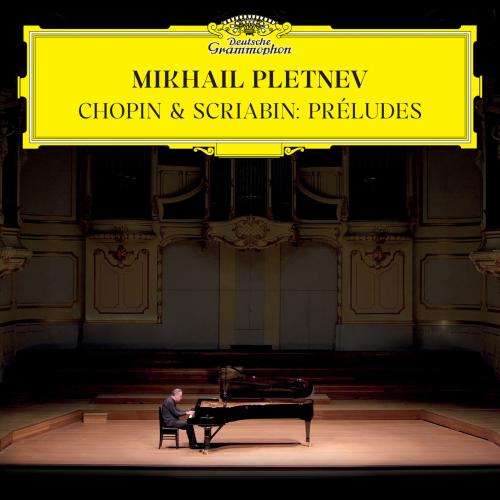
Chopin & Scriabin: 24 Preludes Mikhail Pletnev
Album info
Album-Release:
2025
HRA-Release:
05.12.2025
Label: Deutsche Grammophon (DG)
Genre: Classical
Subgenre: Instrumental
Artist: Mikhail Pletnev
Composer: Frederic Chopin (1810-1849), Alexander Scriabin (1872-1915)
Album including Album cover Booklet (PDF)
I`m sorry!
Dear HIGHRESAUDIO Visitor,
due to territorial constraints and also different releases dates in each country you currently can`t purchase this album. We are updating our release dates twice a week. So, please feel free to check from time-to-time, if the album is available for your country.
We suggest, that you bookmark the album and use our Short List function.
Thank you for your understanding and patience.
Yours sincerely, HIGHRESAUDIO
- Frédéric Chopin (1810 - 1849): 24 Preludes, Op. 28:
- 1 Chopin: 24 Preludes, Op. 28: No. 1 in C Major. Agitato 00:42
- 2 Chopin: 24 Preludes, Op. 28: No. 2 in A Minor. Lento 01:34
- 3 Chopin: 24 Preludes, Op. 28: No. 3 in G Major. Vivace 01:06
- 4 Chopin: 24 Preludes, Op. 28: No. 4 in E Minor. Largo 01:51
- 5 Chopin: 24 Preludes, Op. 28: No. 5 in D Major. Molto allegro 00:42
- 6 Chopin: 24 Preludes, Op. 28: No. 6 in B Minor. Lento assai 01:45
- 7 Chopin: 24 Preludes, Op. 28: No. 7 in A Major. Andantino 00:35
- 8 Chopin: 24 Preludes, Op. 28: No. 8 in F-Sharp Minor. Molto agitato 02:01
- 9 Chopin: 24 Preludes, Op. 28: No. 9 in E Major. Largo 01:01
- 10 Chopin: 24 Preludes, Op. 28: No. 10 in C-Sharp Minor. Molto allegro 00:36
- 11 Chopin: 24 Preludes, Op. 28: No. 11 in B Major. Vivace 00:53
- 12 Chopin: 24 Preludes, Op. 28: No. 12 in G-Sharp Minor. Presto 01:23
- 13 Chopin: 24 Preludes, Op. 28: No. 13 in F-Sharp Major. Lento 02:49
- 14 Chopin: 24 Preludes, Op. 28: No. 14 in E-Flat Minor. Allegro 00:42
- 15 Chopin: 24 Preludes, Op. 28: No. 15 in D-Flat Major "Raindrop Prelude" 04:39
- 16 Chopin: 24 Preludes, Op. 28: No. 16 in B-Flat Minor. Presto con fuoco 01:12
- 17 Chopin: 24 Preludes, Op. 28: No. 17 in A-Flat Major. Allegretto 03:02
- 18 Chopin: 24 Preludes, Op. 28: No. 18 in F Minor. Molto allegro 01:16
- 19 Chopin: 24 Preludes, Op. 28: No. 19 in E-Flat Major. Vivace 01:16
- 20 Chopin: 24 Preludes, Op. 28: No. 20 in C Minor. Largo 01:07
- 21 Chopin: 24 Preludes, Op. 28: No. 21 in B-Flat Major. Cantabile 01:50
- 22 Chopin: 24 Preludes, Op. 28: No. 22 in G Minor. Molto agitato 00:50
- 23 Chopin: 24 Preludes, Op. 28: No. 23 in F Major. Moderato 00:58
- 24 Chopin: 24 Preludes, Op. 28: No. 24 in D Minor. Allegro appassionato 03:00
- Alexander Scriabin (1872 - 1915): 24 Preludes, Op. 11:
- 25 Scriabin: 24 Preludes, Op. 11: No. 1 in C Major. Vivace 01:10
- 26 Scriabin: 24 Preludes, Op. 11: No. 2 in A Minor. Allegretto 02:24
- 27 Scriabin: 24 Preludes, Op. 11: No. 3 in G Major. Vivo 00:53
- 28 Scriabin: 24 Preludes, Op. 11: No. 4 in E Minor. Lento 01:21
- 29 Scriabin: 24 Preludes, Op. 11: No. 5 in D Major. Andante cantabile 01:30
- 30 Scriabin: 24 Preludes, Op. 11: No. 6 in B Minor. Allegro 00:51
- 31 Scriabin: 24 Preludes, Op. 11: No. 7 in A Major. Allegro assai 00:49
- 32 Scriabin: 24 Preludes, Op. 11: No. 8 in F-Sharp Minor. Allegro agitato 02:24
- 33 Scriabin: 24 Preludes, Op. 11: No. 9 in E Major. Andantino 01:16
- 34 Scriabin: 24 Preludes, Op. 11: No. 10 in C-Sharp Minor. Andante 01:26
- 35 Scriabin: 24 Preludes, Op. 11: No. 11 in B Major. Allegro assai 01:27
- 36 Scriabin: 24 Preludes, Op. 11: No. 12 in G-Sharp Minor. Andante 01:28
- 37 Scriabin: 24 Preludes, Op. 11: No. 13 in G-Flat Major. Lento 01:29
- 38 Scriabin: 24 Preludes, Op. 11: No. 14 in E-Flat Minor. Presto 01:03
- 39 Scriabin: 24 Preludes, Op. 11: No. 15 in D-Flat Major. Lento 01:35
- 40 Scriabin: 24 Preludes, Op. 11: No. 16 in B-Flat Minor. Misterioso 02:03
- 41 Scriabin: 24 Preludes, Op. 11: No. 17 in A-Flat Major. Allegretto 00:34
- 42 Scriabin: 24 Preludes, Op. 11: No. 18 in F Minor. Allegro agitato 01:01
- 43 Scriabin: 24 Preludes, Op. 11: No. 19 in E-Flat Major. Affettuoso 01:27
- 44 Scriabin: 24 Preludes, Op. 11: No. 20 in C Minor. Appassionato 01:08
- 45 Scriabin: 24 Preludes, Op. 11: No. 21 in B-Flat Major. Andante 01:55
- 46 Scriabin: 24 Preludes, Op. 11: No. 22 in G Minor. Lento 01:10
- 47 Scriabin: 24 Preludes, Op. 11: No. 23 in F Major. Vivo 00:45
- 48 Scriabin: 24 Preludes, Op. 11: No. 24 in D Minor. Presto 00:58
Info for Chopin & Scriabin: 24 Preludes
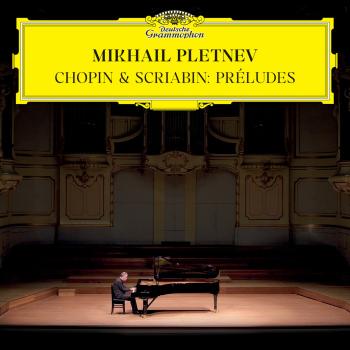
Mikhail Pletnev releases his first studio album with Deutsche Grammophon since 2005. The artistic versatility of the pianist, conductor, and composer is reflected in the unique expressiveness of his interpretations of two significant prelude cycles: Chopin's 24 Préludes, Op. 28 and Scriabin's 24 Préludes, Op. 11. With his unmistakable sound, the legendary Russian artist captures the character of each individual piece.
This is a release full of surprises that defies every cliché. Originally intended as a concert recording, it was ultimately recorded in the studio. This is fortunate for all listeners, as what emerged from the studio recording in a single four-and-a-half-hour session can only be described as pure magic, whether this was coincidence or the intervention of a higher musical providence.
Pletnev recorded the album on his favourite instrument: a Shigeru Kawai grand piano that he alone plays, and which is brought to all his concerts. Its tonal palette and clarity lend his interpretations additional depth.
This recording is a sensation for another reason: it's the first purely analogue DG new production since the 1980s! Pletnev's performance was captured using custom-made Sennheiser microphones and a Studer C37 tube tape machine, and edited using traditional cutting and splicing techniques. The result is a sound that is both authentic and full of warm musicality, bringing life and depth to the original.
Mikhail Pletnev, piano
Mikhail Pletnev
was born in Archangelsk, which is located in the north of Russia on the coast of the White Sea. By the time Pletnev began piano studies at age seven, with pianist Julia Shaskina, his family had moved to the central Russian City of Kazan in Tatarstan. Pletnev demonstrated promise and was enrolled at age 13 in Evgeny Timakin's piano preparatory class at the Moscow Central Music School. At 14, Pletnev earned the Grand Prix awarded by the International Jeunesses Musicales in Paris, and at 15 he transferred into master classes headed by Yakov Flier at the Moscow Conservatory. It was under Flier that Pletnev's talent really took wing, and after taking the gold medal at the All-Union Competition in 1977, Pletnev won the coveted gold at the Tchaikovsky Competition in 1978. "Having rehearsed for the Tchaikovsky Competition under (Flier's) guiding hand," Pletnev once remembered, "I effectively performed there in his name."
Having paid his dues in the tough Russian competition circuit, Pletnev was now free to tour, and appeared on the concert circuit to worldwide acclaim. Critics from London, to New York, and to Tokyo alike praised Pletnev's interpretations of Scarlatti, Liszt, Mozart, Haydn, Beethoven, Chopin, and other primarily mainstream piano composers. Some critics likened Pletnev's approach to that of Michelangeli or Horowitz. In particular, Pletnev is recognized by his affinity for Tchaikovsky, and the pianist has prepared his own transcriptions of Tchaikovsky's ballet The Nutcracker, as well as recasting his opera Eugene Onegin as a ballet.
As the Berlin Wall came down, Pletnev was in the process of founding and organizing the Russian National Orchestra in Moscow. Since that time Pletnev has appeared less often in public as a pianist; he took up the mantle of conductor of the RNO and held the post until 1999. The orchestra under Pletnev made several critically acclaimed recordings for Deutsche Grammophon, including an award-winning set of Tchaikovsky's six symphonies released in 1996. Pletnev also took the orchestra on a tour to the United States during the 1992-1993 season. In addition to his world-class skills with the baton and at the keyboard, Pletnev is also a better-than-average amateur violinist, and finds the time to compose orchestral pieces and chamber music.
The Russian National Orchestra (Russkiy Natsional'niy Orkestr)
is one of the newest international-quality orchestras in the world and is a symbol of societal and government changes in Russia. (It should not be confused with the Russian National Philharmonic Orchestra, Russia's oldest orchestra, based in Tomsk, Siberia.)
President Mikhail Gorbachev's policies of Openness (glasnost') and Rebuilding (perestroika) permitted the founding in 1990 of the first independent orchestral organization since 1918, the Russian National Orchestra. Its founder was the Tchaikovsky Prize-winning pianist and conductor Mikhail Pletnev. Promising an agenda that was driven by artistic considerations and an actual ownership share in the orchestra, the RNO succeeded in attracting the best players from the state-owned orchestras, especially those who were tired of concerts and compositions designed to promote Communist Party agendas. The first concert, in November, 1990, (nine months before the total collapse of Communist rule and reversion of the country to its old name of Russia), revealed an orchestra that was already first rate in execution and individual tone and well on the way of blending into a first rate ensemble.
The orchestra is funded entirely from private sources (foundations, corporations, and individuals from around the world), and is governed by a multinational board of trustees. It has important outreach programs, including its innovative arts and music program for children, "The Magic of Music." It often travels to give special concerts and presentations at orphanages and homes for handicapped children.
Its first recording, of Tchaikovsky's Pathetique Symphony in an exciting performance led by Pletnev, quickly generated international demand. It was the first Russian orchestra invited to play in Israel and at the Vatican, and it toured widely.
Since 1993, the orchestra has recorded extensively for Deutsche Grammophon and has produced outstanding recordings of music of Rachmaninov and Prokofiev in particular. It also has a recording arrangement with an American independent label, Well-Tempered Production, which, in addition to recording the whole orchestra, planned to produce a series of discs of music played by the various chamber ensembles the orchestra has formed out of its membership.
In 1999, it appointed violinist-conductor Vladimir Spivakov as its principal conductor and music director.
Booklet for Chopin & Scriabin: 24 Preludes