


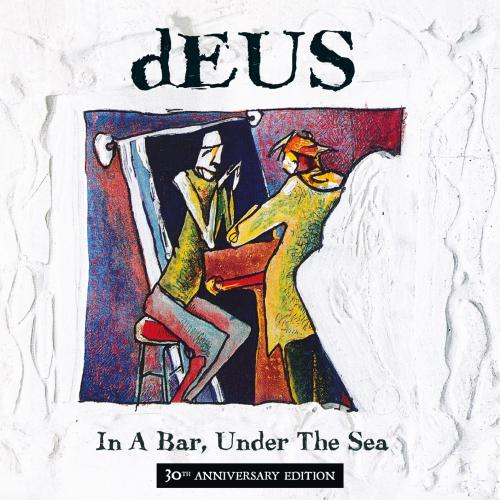
In A Bar, Under The Sea (30th Anniversary Edition Remastered) dEUS
Album info
Album-Release:
2026
HRA-Release:
06.03.2026
Album including Album cover
Coming soon!
Thank you for your interest in this album. This album is currently not available for sale but you can already pre-listen.
Tip: Make use of our Short List function.
- 1 I Don't Mind What Ever Happens 00:47
- 2 Fell Off the Floor, Man 05:15
- 3 Opening Night 01:39
- 4 Theme from Turnpike 05:46
- 5 Little Arithmetics 04:22
- 6 Gimme The Heat 07:36
- 7 Serpentine 03:16
- 8 A Shocking Lack Thereof 05:51
- 9 Supermarketsong 01:58
- 10 Memory Of A Festival 01:53
- 11 Guilty Pleasures 04:23
- 12 Nine Threads 03:28
- 13 Disappointed in the Sun 06:04
- 14 Roses 04:52
- 15 Wake Me Up Before I Sleep 02:51
- 16 Worried About Satan 01:10
- 17 Overflow 03:30
- 18 My Little Contessa 03:29
- 19 My Wife Jan 03:19
- 20 The Tugboat 02:22
- 21 Everything Is The Same (Except No One Believes Me) 02:29
- 22 I Suffer Rock 02:36
- 23 Difficult Day 02:07
- 24 Me And Your Mother 01:47
- 25 Opening Night (Live, 'Basta' at Studio Brussel) 02:31
- 26 Roses (Vermeersch Version) 04:27
- 27 A Shocking Lack Thereof (Demo Version) 03:19
- 28 Nine Threads (Demo Version) 01:26
Info for In A Bar, Under The Sea (30th Anniversary Edition Remastered)
"In a Bar Under the Sea" pushed that logic to its breaking point. Looser, stranger, and more communal in spirit, the album folded jazz phrasing, off-kilter pop hooks, and moments of near-chaos into something that still somehow cohered. It captured a band refusing to settle, embracing excess and experimentation at a moment when European guitar music rarely dared to sound this restless or this alive.
dEUS second album In a Bar, Under the Sea remastered and added with B-sides and rarities for the first time. Includes ‘Roses’, Theme From Turnpike’ and ‘Little Arithmetics’.
"Producing the opening track "I Don't Mind Whatever Happens" to sound like a scratchy blues track from 1930 may well be the little joke of either the band or producer Eric Drew Feldman in homage to his former boss Captain Beefheart. The results work pretty well anyway, though, and that characterizes the same "try it, let's see what happens" spirit through In a Bar. Having established its own sense of savvy white boy urban blues on Worst Case Scenario, the band explores more ways around it on its second effort, generally favoring a quieter, calmer result throughout. New guitarist Craig Ward fits into the lineup well, business carrying along as usual in its striking way. Feldman proves to be an excellent guy to have behind the boards; whether it's he or the band who figures out some of the fantastic stop on a dime shifts and arrangements throughout, all work together with great results. Clever sampling once again crops up: Mingus' "Far Wells, Mill Valley" gets a nod on the smoky snarl "Theme From Turnpike." "Fell Off the Floor, Man" is another high-point, so accomplished and sly in its genre shifting and moods that Beck could be envious. Scott McCloud of Girls Against Boys, a perfectly appropriate guest, takes a bow with some spoken word philosophy, but it's the band's blend of low, spoken vocals, weird harmonies, and sudden shifts between tight rhythms and slabs of feedback that make it all work. Another American takes a bow as well -- Dana Colley, saxophonist for Morphine, on the brief "Supermarketsong" -- but mostly it's all dEUS proving that Belgians can indeed rock. Whether it's the gentle strum and swing (then much more intense break) of "Little Arithmetics," the Built to Spill five years before its time pace and delivery of "Gimme the Heat," or the lovely piano-into-guitar anthem "Disappointed in the Sun," In a Bar is worth the finding." (Ned Raggett, AMG)
Stef Kamil Carlens, vocal, guitar, bass, double bass, percussion, claps
Tom Barman, vocal, guitar, Hammond, Talkback, samples, percussion, synthesizer, cma^s
Jules de Borgher, drums, percussion, bells, claps
Craig Ward, vocal, guitar, sax, mandolin, claps, ukulele, slide guitar
Klaas Janzoons, vocal, percussion, Talkback, piano, violin, synthesizer, beatbox, claps
Rudy Trouvé, vocal, piccolo, harmonica, guitar, ukulele
Guest musicians:
Didier Fontaine, vocal
Scott McCloud, "philosophy"
Eric Drew Feldman, Hammond, percussion, egg, piano
Pieter Lamot, trombone
Ian Humphries, violin
Charles Mutter, violin
Nic Pendlebury, viola
Deirdre Cooper, cello
Dana Colley, saxophones
Vincienne, claps
Jim Brumby, claps, rate and depth
Piet Jorens, piano, gong
Bart Maris, trumpet
Digitally remastered
dEUS
The Belgian indie scene, experts agree, is considered the most creative as well as progressive in all of Europe - and dEUS are its commercial and artistic spearhead. In this scene there are numerous musicians who combine the most diverse genres in several formations in parallel and are often active in other art forms as well. This was also the case when dEUS was founded in 1991: the core of this extremely open-minded band was formed by the documentary filmmaker Tom Barman, the painter and sculptor Rudy Trouvé, and the fashion designer Stef Kamil Carlens. The three, supplemented by two other musicians, including violinist Klaas Janzoons, who is still a member of the band today, were socialized so differently artistically that a joint result almost automatically had to break all known boundaries.
Thus, the debut album "Worst Case Scenario", released in 1994, already showed a breathtaking stylistic heterogeneity between jazz, folk, noise, alternative and experimental rock, which could not hide its clear reference to artists like Frank Zappa, Captain Beefheart or Tom Waits. The band then went almost wilder on their second album, "In a Bar, Under the Sea" (1996), a masterpiece of versatility that ultimately could only be blamed for one thing: it was hard to imagine that all this different music should come from a single band. Despite this challenging experimentation and thanks to overwhelming reviews from the experts, however, dEUS achieved an international breakthrough with these two albums.
This was followed by the first of several caesuras in the band's now 31-year history. Trouvé and Carlens left the band and founded their own highly acclaimed bands Kiss My Jazz and Zita Swoon. In their place as creative counterparts to bandleader Tom Barman came the Scotsman Craig Ward, and with him came a new approach: How would it be to present all these genres not just side by side, but closely interwoven with each other to generate a work of art that, for all its versatility, sounded rounded, coherent and homogeneous? The first result of this second dEUS era was called "The Ideal Crash" (1999) and is considered one of the best albums in the history of indie rock. Every single song turned out to be a compositional jewel, carefully but purposefully equipped with the necessary details. No wonder that dEUS took a break of several years after this over-work. After that, all members pursued other music or art projects.
It wasn't until 2004 that dEUS reunited, once again in a heavily modified version; of the founding members, only Barman and Janzoons have been around since then, while Barman recruited the other musicians from the multitude of outstanding bands from Antwerp and Ghent, including Soulwax drummer Stéphane Misseghers and musical jack-of-all-trades Mauro Pawlowski, who had explored the boundaries of what was absolutely feasible and audible in indie rock with more than half a dozen formations. Since then, four more dEUS albums have been released, all of which have been acclaimed by press and fans alike, giving dEUS a special place in European indie rock history as a rarely consistent and consistent band that simply cannot make an average album. Expectations are correspondingly high for their upcoming eighth record - the first since their last long-player to date, 2012's "Following Sea".
This album contains no booklet.