


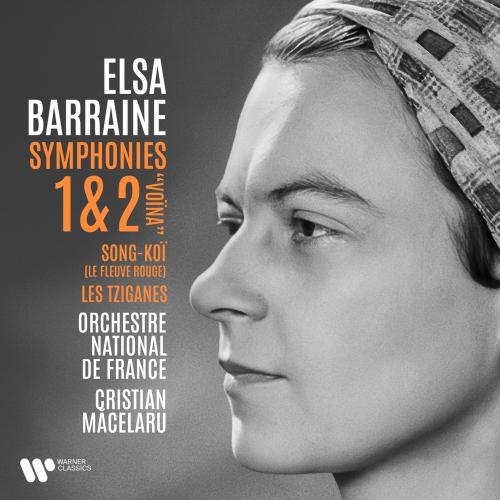
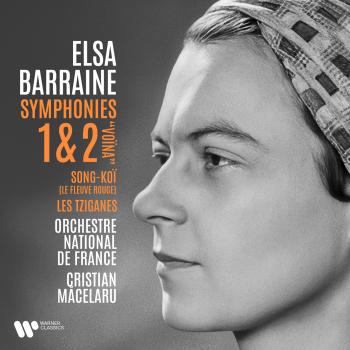
Barraine: Symphonies Nos. 1 & 2 "Voïna", Song-Koï & Les Tziganes Orchestre National de France & Cristian Măcelaru
Album info
Album-Release:
2026
HRA-Release:
20.02.2026
Label: Warner Classics
Genre: Classical
Subgenre: Orchestral
Artist: Orchestre National de France & Cristian Măcelaru
Composer: Elsa Barraine (1910-1999)
Album including Album cover Booklet (PDF)
I`m sorry!
Dear HIGHRESAUDIO Visitor,
due to territorial constraints and also different releases dates in each country you currently can`t purchase this album. We are updating our release dates twice a week. So, please feel free to check from time-to-time, if the album is available for your country.
We suggest, that you bookmark the album and use our Short List function.
Thank you for your understanding and patience.
Yours sincerely, HIGHRESAUDIO
- Elsa Barraine (1910 - 1999): Song-Koï:
- 1 Barraine: Song-Koï: I. La source 00:57
- 2 Barraine: Song-Koï: II. La haute plaine 00:44
- 3 Barraine: Song-Koï: III. Les chemins célestes 02:32
- 4 Barraine: Song-Koï: IV. La ville de Son-Phong 03:29
- 5 Barraine: Song-Koï: V. Le retour des pavillons noirs 01:58
- 6 Barraine: Song-Koï: VI. La rivière Noire 01:44
- 7 Barraine: Song-Koï: VII. Le fleuve Rouge reçoit la rivière Noire 03:01
- 8 Barraine: Song-Koï: VIII. L’arrivée à la mer et la mort 01:38
- Symphony No. 1:
- 9 Barraine: Symphony No. 1: I. Andante - Vivace 09:11
- 10 Barraine: Symphony No. 1: II. Adagio - Vivace 10:34
- 11 Barraine: Symphony No. 1: III. Finale. Adagio - Allegro giocoso e leggiero 08:29
- Symphony No. 2 "Voïna":
- 12 Barraine: Symphony No. 2 "Voïna": I. Adagio - Allegro moderato 07:20
- 13 Barraine: Symphony No. 2 "Voïna": II. Marche funèbre. Lento 05:17
- 14 Barraine: Symphony No. 2 "Voïna": III. Finale. Allegretto 04:54
- Les Tziganes:
- 15 Barraine: Les Tziganes 04:36
Info for Barraine: Symphonies Nos. 1 & 2 "Voïna", Song-Koï & Les Tziganes
The National Orchestra of France, led by Cristian Macelaru, dedicates an album to composer Elsa Barraine, an important figure in 20th century French music. Paul Dukas student and winner of the Rome Prize at 19, Elsa Barraine has led a career both artistic and public, marked by her commitment to Resistance. This new recording brings together four of his orchestral works, the Symphonies No. 1 and 2, Song-Koi (The Red River) and The Gypsies, which testify to his mastered writing, expressiveness and deep sensitivity to the upheavals of his time.
The composer Balene lived through a time of oppression. His burning spirit and noble music are revived here. Elsa Balene (1910-1999) was a remarkable and politically daring figure in her own lifetime, a composer whose unique compositional language has been revisited in recent years. A student of Paul Ducasse at the Paris Conservatory and a fellow student of Olivier Messiaen, she won the highly prestigious Prix de Rome for her cantata on Jeanne d'Arc at the age of only 19.During his long career, he held key positions in French music and held a professorship for more than 20 years, but he was also a composer with strong left-wing convictions and played an important role in the resistance during the occupation during World War II. This album features four works by Balène under the direction of Christian Macheral, music director of the Orchestre National de France.The "Symphony No. 1," completed in Italy in 1931; the tight but robust "Symphony No. 2," composed in 1938 and subtitled ominously in French "Voina," Russian for "War"; the "Red River," written in 1945 - the year Vietnam declared its independence from France - and in eight movements, flowing through Vietnam; and the "Tzigane," dating back to 1959 - perhaps the year the radio program "The Red River" was broadcast. The Red River", written in 1945 - the year Vietnam declared its independence from France - and in eight movements, depicts the Red River flowing through Vietnam, and "Tzigane", dating back to 1959 - probably written for a radio program, and named after the name. The "Tzigane" was written in 1959, probably for a radio program, and as the name suggests, inspired by Gypsy culture.While rooted in tonality, Barlaine's music is characterized by a confident, neat construction and a clear yet delicately colored orchestral sound that reflects the ideological and spiritual concerns of the times and the composer himself. During World War II, Balaine's resistance activities were organized by the Musicians' National Front, which she founded with conductor Roger Desormier and composer Louis Duret, an organization tied to the French Communist Party. Even more dangerous for her activities was the fact that her father was Jewish. Several of her works deal with Jewish themes, notably the symphonic poem "Pogroms," composed in 1933 and inspired by the poetry of André Speer.In 1941, her father Matheu was forced out of his position as principal cellist of the Paris Opera Orchestra, and he died two years later. Toward the end of the war, Balene, who was often on the verge of arrest for her resistance activities, took the step of living under the pseudonym Catherine Bonnard. During the post-liberation period, Balene received great acclaim. After the war, she received numerous commissions for concert halls, theaters, films, and radio broadcasts, including "The Red River," which was premiered to great acclaim in London by the BBC Symphony Orchestra. One such commission was "The Red River," which was premiered by the Orchestre National de Radio France, the predecessor of today's Orchestre National de France, under the baton of Manuel Rosantal.
L'Orchestre National de France
Cristian Macelaru, conductor
No biography found.
Booklet for Barraine: Symphonies Nos. 1 & 2 "Voïna", Song-Koï & Les Tziganes