



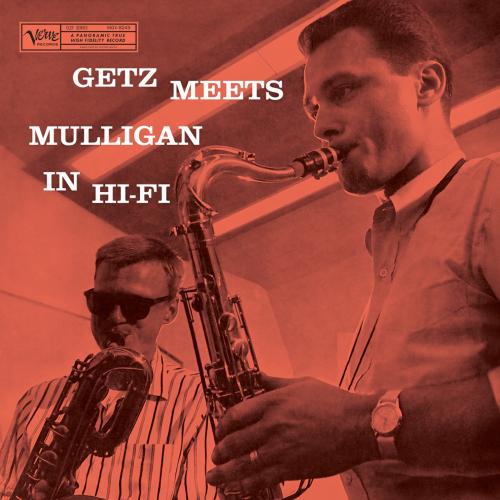
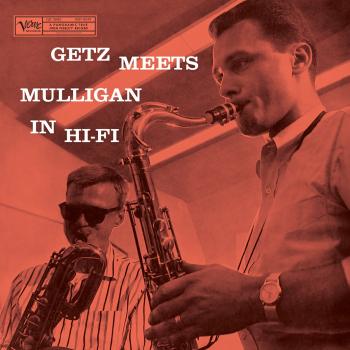
Getz Meets Mulligan In Hi-Fi (2025 Mono Remaster) Stan Getz, Gerry Mulligan
Album info
Album-Release:
2026
HRA-Release:
30.01.2026
Album including Album cover
I`m sorry!
Dear HIGHRESAUDIO Visitor,
due to territorial constraints and also different releases dates in each country you currently can`t purchase this album. We are updating our release dates twice a week. So, please feel free to check from time-to-time, if the album is available for your country.
We suggest, that you bookmark the album and use our Short List function.
Thank you for your understanding and patience.
Yours sincerely, HIGHRESAUDIO
- 1 Let's Fall In Love 06:29
- 2 Anything Goes 03:39
- 3 Too Close For Comfort 06:58
- 4 That Old Feeling 05:59
- 5 This Can't Be Love 08:48
- 6 Ballad 05:46
Info for Getz Meets Mulligan In Hi-Fi (2025 Mono Remaster)
Under the guidance of Norman Granz, Stan Getz and Gerry Mulligan collaborate for the first time as the primary horns on "Getz Meets Mulligan in Hi-Fi". Recorded in 1957, this record offers the unique opportunity to listen to the two jazz stars trade instruments on the first three tracks ("Let's Fall in Love," "Anything Goes" and "Too Close for Comfort") with Getz on baritone sax and Mulligan on tenor. The music gels with the help of a world-class rhythm section featuring Lou Levy on piano, Ray Brown on bass, and Stan Levey on drums. While a massive musical success, the duo never recorded again in this quintet format, making this record a rarity.
‘This album is not an attempt to dazzle with effects or gimmicks, but rather proof that two masters of their craft, attuned to each other and free in their expression, can create timeless music that still conveys energy, warmth and inspiration decades later.’ (Michael Haifl, saitenkult.de)
Gerry Mulligan, baritone saxophone (tracks 4–8), tenor saxophone (tracks 1–3)
Stan Getz, tenor saxophone (tracks 4–8), baritone saxophone (tracks 1–3)
Lou Levy, piano
Ray Brown, bass
Stan Levey, drums
Digitally remastered by Matthew Lutthans
Stan Getz
Tenor saxophonist Stan Getz was one of the most elegant melodists in modern jazz. His pleasantly meandering lines, but above all his velvety, soft and at the same time powerfully determined tone, have decisively shaped the sound of the demanding mainstream since the fifties and the bossa nova wave of the sixties.
Stanley Gayetzsky was born on February 2, 1927 in Philadelphia and grew up in the Bronx, the son of a Jewish printer. Encouraged vehemently by his ambitious mother, he played in school bands as a child, first playing the harmonica, bass and bassoon, and later the alto and tenor saxophone. He was gifted and had a scholarship to the Juilliard School almost in his pocket when he could no longer stand it at home and broke away from his family's narrow circumstances. He ran away, turned to jazz, went on tour with Dick Rodgers at the age of 15 and a year later was already heard in Jack Teagarden's ensemble, who immediately took over the guardianship of the teenager until he came of age. He quickly became one of the most accomplished composition players of his time and was engaged in the orchestras of Stan Kenton (1945/6), Jimmy Dorsey, Benny Goodman and Herbie Fields. He moved to the West Coast around 1946 and worked in Hollywood with his own trio, but also with Nat Cole and other orchestras.
Getz took the next important career step when he joined Woody Herman's bebop big band “Second Herd” in 1947, together with Jimmy Giuffre (later Serge Chaloff), Herbie Stewart and Zoot Sims as the “Four Brothers”. He was part of the brass section of those years and became known far beyond jazz specialist circles thanks to his sensational solo on “Early Autumn” (1948). Getz stayed with Herman until 1949, then worked as an established sideman and bandleader in a variety of projects alongside stars such as Ella Fitzgerald, Sarah Vaughan, Dizzy Gillespie and as part of the renowned “Jazz At The Philharmonic” concerts. However, his increasing drug addiction put him under so much pressure that in the mid-1950s, after a pharmacy robbery and a suicide attempt, he ended up first in prison and then in a rehabilitation center.
After this involuntary career break, Getz made a remarkable comeback at the beginning of the sixties. In addition to the classical crossover recording “Focus” (1961), which is unique in jazz history, together with Eddie Sauter, it was above all the collaboration with the guitarist Charlie Byrd (“Jazz Samba”, 1962), the Brazilian composer Antonio Carlos Jobim and Gilberto couple (“The Girl From Ipanema”, 1965), who brought him back to the stage. Getz became a style role model of the bossa nova wave through buttery solos like in “Desafinado” and was again a much-booked soloist for a wide variety of projects well into the 1970s. Own bands with the pianist Chick Corea were enthusiastically celebrated at festivals such as in Berlin in 1966, but proved to have little lasting power.
During the following years, Getz tried out new line-ups, lived in Europe from 1969 to 1972 and was sometimes at the side of Airto Moreira and Tony Williams, sometimes with lyrical small groups such as the duo “The Peacocks” (1975) with the pianist Jimmy Rowles to hear. During the 1980s he developed an enormous recording activity from “Autumn Leaves” (1980) to “People Time” (1991), documented by several dozen albums. From 1985 onwards, he helped Stanford University set up the young Jazz Department and, as a lecturer, passed on his experiences to the next generation. The following year he was elected to the “Hall of Fame” by readers of the influential Down Beat magazine. Although he was already suffering from liver cancer, he remained on stage until the very end and could be seen live at the North Sea Festival in The Hague in 1990, where he was also presented with the renowned “Bird Award”. Stan Getz died on June 6, 1991 in Los Angeles.
This album contains no booklet.