





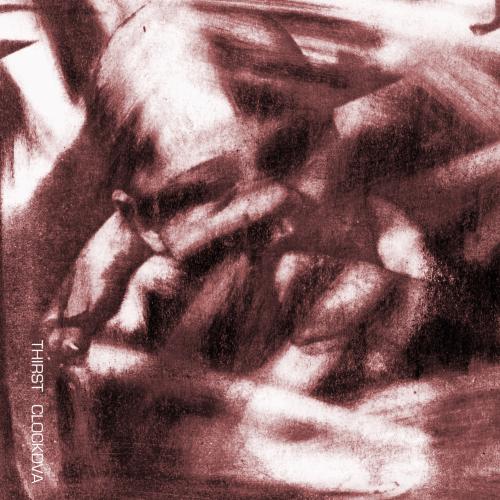
Thirst (2026 Remaster) Clock DVA
Album info
Album-Release:
1981
HRA-Release:
05.06.2026
Album including Album cover
- 1 Uncertain (2026 Remaster) 07:09
- 2 Sensorium (2026 Remaster) 02:37
- 3 White Cell (2026 Remaster) 04:36
- 4 Piano Pain (2026 Remaster) 03:15
- 5 Blue Tone (2026 Remaster) 05:55
- 6 North Loop (2026 Remaster) 04:52
- 7 4 Hours (2026 Remaster) 03:51
- 8 Moments (2026 Remaster) 06:26
- 9 Impressions of African Winter (2026 Remaster) 05:28
- 10 The Opening (2026 Remaster) 05:47
- 11 Remain Remain (2026 Remaster) 02:46
- 12 4 Hours (Single Mix) 03:52
- 13 Sensorium (Single Mix) 02:39
- 14 4 Hours (DVATION 2026 Version) 04:00
- 15 Sensorium (DVATION 2026 Version) 08:24
Info for Thirst (2026 Remaster)
“Thirst”, first released in 1981 on Fetish Records, captured the band as they shifted from the more improvised, tape-driven approach of their debut into a sharper, song-based framework.
Adi Newton explains in the accompanying notes that the material on “Thirst” emerged from a deliberate move toward more structured pieces, following the personnel change from David Hammond to Paul Widger on guitar. The record balances jazz-inflected saxophone work from Charlie Collins with rigid rhythm section patterns and Newton’s characteristic vocals.
Adi Newton, vocals, clarinet, tape, production
Turner (Steven James Turner), bass, treatments
Roger Quail, drums
Paul Widger, guitar
Charlie Collins, saxophones, African flute, African thumb piano
Recorded at Jacobs Studio in Surrey
Produced and engineered by Ken Thomas
Digitally remastered
Clock DVA
are an industrial/post-punk/EBM group from Sheffield, formed in 1978 by Adi Newton (Adolphus Newton) and Steven “Judd” Turner. The name combines Anthony Burgess’ Nadsat slang from A Clockwork Orange with the Slavic word for “two”.
In their early phase, the band worked with treated tape loops, EMS Synthi E electronics and improvised structures, releasing cassette-only material before issuing the debut album “White Souls in Black Suits” in 1980 on Industrial Records. This debut, recorded at Cabaret Voltaire’s Western Works studio, later returned in a remastered double grey-vinyl and CD edition on The Grey Area of Mute in December 2025, extended with four contemporaneous tracks.
“Thirst”, issued in 1981 on Fetish Records, followed as their first fully studio-based LP and reached the top of the UK indie charts. After this period, Newton steered the project toward a more electronic direction, signing to Polydor for “Advantage” (1983) before moving further into sample-based and cybernetic themes on late-80s and early-90s releases such as “Buried Dreams” (1989), “Transitional Voices” (1990), “Man-Amplified” (1991) and “Digital Soundtracks” (1992), culminating in “Sign” (1993).
Parallel to the main band, Newton launched The Anti Group Communications (T.A.G.C.) as a vehicle for psycho-acoustic and multimedia research. We previously covered the Cold Spring reissue of the 1994 album “Iso-Erotic Calibration” by this project.
Clock DVA entered a long hiatus after the mid-1990s, with Newton concentrating on T.A.G.C. and archival work, before reactivating the band in 2008 with a new line-up that has since performed at festivals and produced new material under the Anterior Research banner. Recent years have seen the catalogue systematically revisited: the “Horology” box sets compiled early recordings, “White Souls in Black Suits” returned in 2025 via The Grey Area of Mute, and the upcoming “Thirst” reissue continues this chronological re-presentation of the group’s early work.
This album contains no booklet.