






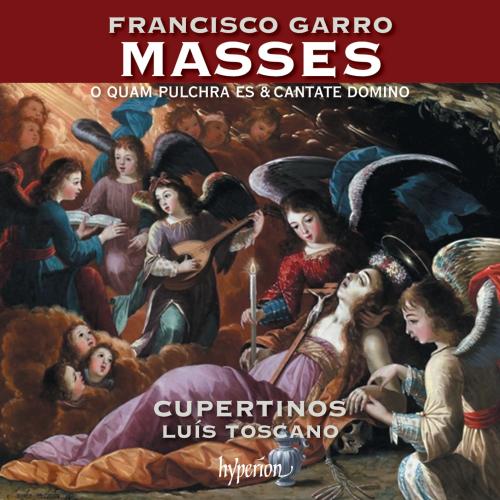
Garro: Missa O quam pulchra es & Cantate Domino Cupertinos & Luís Toscano
Album info
Album-Release:
2026
HRA-Release:
27.02.2026
Label: Hyperion
Genre: Classical
Subgenre: Vocal
Artist: Cupertinos & Luís Toscano
Composer: Francisco Garro (1556-1623)
Album including Album cover Booklet (PDF)
I`m sorry!
Dear HIGHRESAUDIO Visitor,
due to territorial constraints and also different releases dates in each country you currently can`t purchase this album. We are updating our release dates twice a week. So, please feel free to check from time-to-time, if the album is available for your country.
We suggest, that you bookmark the album and use our Short List function.
Thank you for your understanding and patience.
Yours sincerely, HIGHRESAUDIO
- Francisco Garro (1556 - 1623): Parce mihi, Domine a 8:
- 1 Garro: Parce mihi, Domine a 8 04:32
- Responde mihi:
- 2 Garro: Responde mihi 04:04
- Spiritus meus:
- 3 Garro: Spiritus meus 04:41
- Asperges me:
- 4 Garro: Asperges me 06:33
- Missa O quam pulchra es:
- 5 Garro: Missa O quam pulchra es: I. Kyrie 03:08
- 6 Garro: Missa O quam pulchra es: II. Gloria 04:41
- 7 Garro: Missa O quam pulchra es: III. Credo 07:30
- 8 Garro: Missa O quam pulchra es: IV. Sanctus & Benedictus 04:14
- 9 Garro: Missa O quam pulchra es: V. Agnus Dei 03:44
- In principio erat verbum:
- 10 Garro: In principio erat verbum 04:27
- Missa Cantate Domino:
- 11 Garro: Missa Cantate Domino: I. Kyrie 02:02
- 12 Garro: Missa Cantate Domino: II. Gloria 04:05
- 13 Garro: Missa Cantate Domino: III. Alleluia. Tanto tempore 04:39
- 14 Garro: Missa Cantate Domino: IV. Credo 05:54
- 15 Garro: Missa Cantate Domino: V. Sanctus & Benedictus 02:47
- 16 Garro: Missa Cantate Domino: VI. Agnus Dei 02:15
Info for Garro: Missa O quam pulchra es & Cantate Domino
Cupertinos continue their much-praised exploration of Portuguese polyphony with an album of works by Francisco Garro. Garro held the position of Master of the Royal Chapel in Lisbon for more than three decades, giving some idea of his contemporary reputation. The two masses featured here are important works; these are the first recordings of both.
The name Francisco Garro (c1556-1623) takes us back to one of the most outstanding and intriguing figures in the history and historiography of music in Portugal. Born in Alfaro—an old Spanish town in the valley of the River Ebro, between Zaragoza and Logroño—he was chapelmaster at the prestigious Sigüenza Cathedral before being appointed Master of the Royal Chapel in Lisbon during the period of the Iberian Union (1580-1640), replacing António Carreira (c1515-c1590). Unquestionably a protagonist on the Portuguese musical scene during the transition between the sixteenth and seventeenth centuries, Garro held that very important position for more than three decades, during which he relied on the collaboration of Filipe de Magalhães (c1563-1652)—who would eventually succeed him—and published two volumes of sacred works, forerunners of the musical editions printed in Portugal using movable type.
Published in 1609 by the pioneering Olisipone press owned by the Flemish printer Pieter van Craesbeeck (c1572-1632), these two volumes—which are the sources for the music recorded here by Cupertinos—follow different formal and conceptual patterns. Looking at the respective frontispieces, we have, on the one hand, Antiphona, Asperges me, quinque vocibus; Antiphona, Vidi aquam, sex vocibus; Missa saeculorum primi toni, quinque vocibus; Missa O quam pulchra es, quatuor vocibus; Missa Tu es qui venturus es, quatuor vocibus; Missa Maria Magdalena, sex vocibus; Motetta In principium erat verbum, quinque vocibus; Parce mihi Domine, quinque vocibus; O magnum misterium, sex vocibus, published as a choirbook; and, on the other hand, Missae quatuor, octonis vocibus tres, & una duodenis; Defunctorum lectiones tres, octonis vocibus; Tria Alleluia, octonis etiam vocibus, published as separate partbooks and dedicated entirely to the polychoral repertoire. ...
Cupertinos
Luis Toscano, conductor
Please Note: we do not offer the 192kHz version of this album, because our analysis clearly showed, that the 192kHz does not reach a frequency spectrum, that would justify to offer 192kHz. Hence we offer the 96kHz version.
Cupertinos
Founded in 2009 by the Cupertino de Miranda Foundation (Vila Nova de Famalicão, Portugal), the vocal ensemble Cupertinos is dedicated almost exclusively to the Portuguese musical heritage of the sixteenth and seventeenth centuries, based on world-famous composers such as Duarte Lobo, Manuel Cardoso, Filipe de Magalhães and Pedro de Cristo.
Giving over fifteen concerts each year, the Cupertinos have presented around 300 works to date, including over 120 modern premieres. Several of these unpublished works have been transcribed from their original sources by members of the Cupertinos themselves under the guidance of music director Luís Toscano and musicologist Professor José Abreu (University of Coimbra and ESMAE).
Besides the International Festival of Portuguese Polyphony that they host, the Cupertinos have participated in renowned music festivals in Portugal, Spain, Italy and Germany. The group’s UK debut in the ‘Choral at Cadogan’ concert series was followed by performances at the Laus Polyphoniae festival in Antwerp and at the Wigmore Hall in London.
Since 2022 the Cupertinos have been members of REMA (Réseau Européen de Musique Ancienne), the most prominent European network dedicated to the safeguarding and dissemination of early music, with 134 members and representatives from over twenty countries.
The Cupertinos are renowned as ‘true ambassadors of Portuguese polyphony’, and this epithet has been greatly enhanced by their earlier albums, dedicated in turn to Manuel Cardoso, Duarte Lobo, Pedro de Cristo and Filipe de Magalhães. Released by Hyperion, these recordings appear regularly on classical radio stations across Europe and North America, and have been acclaimed by BBC Music Magazine, Gramophone, Choir & Organ and Chorzeit, among others. Their debut album was nominated for a Preis der deutschen Schallplattenkritik, and won a 2019 Gramophone Award in the ‘Early Music’ category. They were finalists in the 2020 ‘PLAY—Portuguese Music Awards’ and in 2021 were winners in the PLAY Best Classical Album category.
Luís Toscano
Having trained as a young chorister in the Coro dos Pequenos Cantores de Coimbra, Luís continued his musical studies at Coimbra Conservatory, while also achieving a Licentiate Diploma in Economy from Coimbra University. He subsequently obtained a Portuguese Government scholarship to research, edit and perform sixteenth- and seventeenth-century Portuguese music, and completed his Masters in Music at Aveiro University. He is now studying for a PhD in Art/Music Studies at Coimbra, where he is a researcher at the Centre for Classical and Humanistic Studies.
Critically acclaimed as ‘a major exponent of Portuguese Renaissance polyphony’ and ‘a musician of refined instinct’, Luís was until 2023 the music director and a member of Cupertinos, with whom he was awarded Gramophone’s Early Music Award in 2019.
Based in Denmark since 2024, Luís is active as director and singer, specializing in pre-Classical and contemporary repertoires. He is a co-founder of vocal ensemble Quarto Tom and a member of Ars Nova Copenhagen. He was a founding member of Coro Casa da Música, and works regularly with other prominent ensembles in Portugal, Spain, Denmark, Ireland and the United Kingdom.
Booklet for Garro: Missa O quam pulchra es & Cantate Domino