







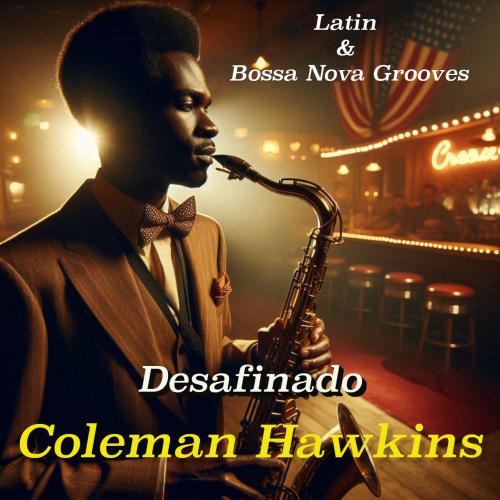
Desafinado: Coleman Hawkins' Latin & Bossa Nova Grooves (Remastered) Coleman Hawkins
Album Info
Album Veröffentlichung:
1963
HRA-Veröffentlichung:
16.02.2026
Das Album enthält Albumcover
Entschuldigen Sie bitte!
Sehr geehrter HIGHRESAUDIO Besucher,
leider kann das Album zurzeit aufgrund von Länder- und Lizenzbeschränkungen nicht gekauft werden oder uns liegt der offizielle Veröffentlichungstermin für Ihr Land noch nicht vor. Wir aktualisieren unsere Veröffentlichungstermine ein- bis zweimal die Woche. Bitte schauen Sie ab und zu mal wieder rein.
Wir empfehlen Ihnen das Album auf Ihre Merkliste zu setzen.
Wir bedanken uns für Ihr Verständnis und Ihre Geduld.
Ihr, HIGHRESAUDIO
- 1 Desafinado 05:57
- 2 O Pato 04:21
- 3 One Note Samba 06:08
- 4 Un Abraco No Bonfa 05:01
- 5 Samba Para Bean 05:36
- 6 La Rosita 06:19
- 7 Blues For Yolande 07:11
- 8 Blues For Yolande (Alt. Take) 03:06
- 9 Blue Lights 05:52
- 10 In A Mellow Tone 04:54
- 11 In A Mellow Tone (Alt. Take) 04:53
- 12 Begin The Beguine 03:11
- 13 Climb Every Mountain 04:39
- 14 Prisoner Of Love 04:22
- 15 Hawk eyes 10:28
- 16 Smoke Gets In Your Eyes 04:45
- 17 Tangerine 05:29
- 18 The World Is Waiting For The Sunrise 03:57
- 19 Indiana (Back Home Again In) 14:26
- 20 It's A Blue World 08:07
- 21 Don't Sit Under The Apple Tree with Anyone Else But Me 04:35
- 22 Laura 04:42
- 23 Quintessence 04:53
- 24 C'Mon in 13:26
- 25 Through For The Night 05:23
Info zu Desafinado: Coleman Hawkins' Latin & Bossa Nova Grooves (Remastered)
The album opens with the samba standard title, "Desafinado," which Hawkins floats through, gliding along the melody playfully, turning and caressing it, making it his own. Throughout the album, Hawkins moves easily through the tender parts of the samba tunes, yet occasionally flashes glimpses of his trademark tenor aggresssion, never allowing the listener to gorget whose in charge. Guitar duo Barry Galbraith and Howard Collins propel and support the tunes, and even take the occasional solo such as on "O Pato (The Duck)." Pianist Tommy Flanagan gives up the ivories for the claves, and proves quite adept. Flanagan, along with percussionist Willie Rodriguez, drummer Eddie Locke and bassist Major Holly from a rhythm syndicate that would hold its own on any corner in Rio de Janeiro.
Even with the outstanding treatments of classic samba tunes like "One Note Samba" and "An Embrace To Bonfa," the highlight of this album is definitely the seemingly out-of-place "I'm Looking Over A Four Leaf Clover." After an introductory groove laid down by Flanagan and Holley, Hawkins swims in carrying the familiar melody above the current, before diving down into the swirling treatment he puts on this traditional favorite. Perhaps it is only fitting for such a seemingly out of place selection to shine the brightest over this most unlikely of masterpieces. (AllAboutJazz)
"That Coleman Hawkins jumped on the jazz/bossa nova bandwagon craze initiated by Stan Getz in 1962 was a bit of a surprise to his fans, but that he was comfortable in the idiom should not be off-putting. Able to adapt to any style over his lengthy career, the legendary tenor saxophonist chose classic standards adapted to Brazilian rhythms, music from masters like Antonio Carlos Jobim and João Gilberto, and a Manny Albam original. Producer Bob Thiele and music director Albam were strong in their resolve directing Hawkins to do this project, and the results are fairly predictable, especially considering that every single track is played in midtempo. The difference is the deployment of two guitarists in Barry Galbraith (lead) and Howard Collins (rhythm) split into separate stereo channels, with bassist Major Holley and no full kit drummer, although Eddie Locke with a minimal and stripped-down setup, Willie Rodriguez, and even Tommy Flanagan play small Latin percussion instruments. Themes derived from nights in Rio such as the beautifully rendered title track and "One Note Samba" are quite typical, but "O Pato" (The Duck) has a component added on from Duke Ellington's "Take the 'A' Train," while the Hawkins original "Stumpy" is adapted into "Stumpy Bossa Nova," derived from Dizzy Gillespie's "Groovin' High" with a taste of "The Man I Love" tacked on at the end. Albam's "Samba Para Bean" is standardized cool with Locke's accents via brushes on closed hi-hat cymbals, while "I Remember You" is a completely unforced, pretty rendition of this well-worn standard. Gilberto's tribute to Luiz Bonfá, "Um Abraco No Bonfa," sports a guitar lead by Galbraith in a stretched-out frame. The curve ball is a somewhat weird crossbred samba take of "I'm Looking Over a Four Leaf Clover," a truly corny song the band tried to make cool, only marginally succeeding. The simplified style of this album overall perfectly suited the amiable, good-natured, and laid-back Hawkins at a time when the world was somewhat in political turmoil regarding Caribbean nations and the role of South America in the emerging so-called Third World. He passed away seven years later, leaving a legacy as the most revered tenor saxophonist in jazz, and this very nice recording in his long discography, unique even unto itself." (Michael G. Nastos, AMG)
Coleman Hawkins, tenor saxophone
Howard Collins, guitar
Barry Galbraith, guitar
Major Holley, bass
Eddie Locke, drums, percussion
Tommy Flanagan, claves
Willie Rodriguez, percussion
Manny Albam, arranger
Recorded September 12 & 17, 1962 at Van Gelder, Englewood Cliffs, New Jersey
Produced by Bob Thiele
Digitally remastered
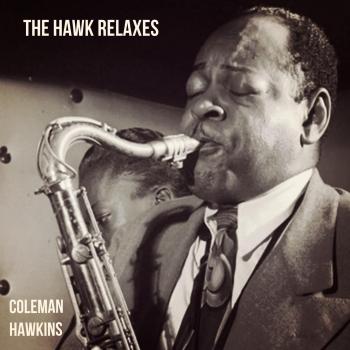
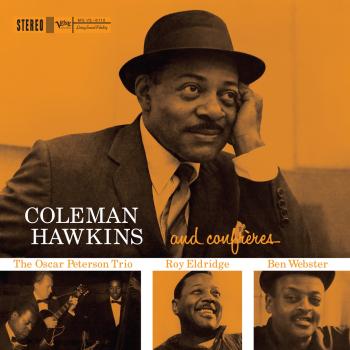

Coleman Hawkins
was born in St. Joseph Missouri in 1904. He attended High School in Topeka Kansas, and subsequently had two years of college music education at Washburn College. Shortly after this period, he would relocate to New York City, where he would begin a long and prosperous tenure with Fletcher Henderson’s Orchestra. He would come in contact with Louis Armstrong during this time, and it would have an incredible impact on Hawkins. He would later go on to tour extensively in Europe before returning to America for another long stretch. Coleman Hawkins is thought of as the first person to bring the tenor saxophone to prominence in jazz music. There were players before him, but he is often credited as being the first to demand that the instrument be taken seriously. His virtuosic approach to improvisation, often consisting of advanced harmonies and arpeggios, was among the first styles to be tailored precisely to the tenor sax. Coleman Hawkins would also go on to be a pioneer of the bebop style, associating with musicians like Dizzy Gillespie, Thelonious Monk, Max Roach, Sonny Rollins, Charlie Parker and others.
Dieses Album enthält kein Booklet