
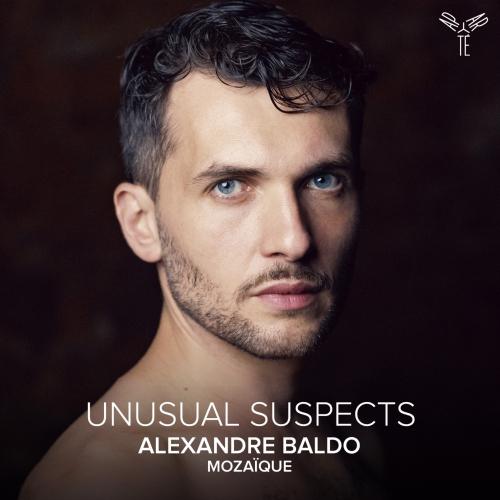
Unusual Suspects Alexandre Baldo & Mozaïque
Album info
Album-Release:
2026
HRA-Release:
20.11.2026
Label: Aparté
Genre: Classical
Subgenre: Vocal
Artist: Alexandre Baldo & Mozaïque
Composer: Nicola Antonio Porpora (1686-1768), Johann Joseph Fux (1660-1741), Georg Friedrich Händel (1685-1759), Antonio Vivaldi (1678-1741), John Frederick Lampe (1702-1751), Christoph Graupner (1683-1760), Benedetto Marcello (1686-1739), John Christopher Smith (1712-1795), Johann Mattheson (1681-1764)
Album including Album cover Booklet (PDF)
Coming soon!
Thank you for your interest in this album. This album is currently not available for sale but you can already pre-listen.
Tip: Make use of our Short List function.
- Nicola Porpora (1686-1768): Arianna in Nasso:
- 1 Porpora: Arianna in Nasso: Ouverture 07:35
- Johann Joseph Fux (1660-1741): Il Fonte della Salute:
- 2 Fux: Il Fonte della Salute: Aria. Puoi peccar quanto tu vuoi (Demonio) 05:39
- Georg Friedrich Händel (1685-1759): Acis and Galatea, HWV 49b:
- 3 Händel: Acis and Galatea, HWV 49b: Aria. Mi palpita il cor… Affanno tiranno (Polifemo) 05:53
- Antonio Vivaldi (1678-1741): Armida al campo d'Egitto, RV 699:
- 4 Vivaldi: Armida al campo d'Egitto, RV 699: Aria. So che combatte ancor (Califfo) 03:45
- John Frederick Lampe (1702-1751): The Dragon of Wantley:
- 5 Lampe: The Dragon of Wantley: Scene and Death of The Dragon (The Dragon) 01:23
- Christoph Graupner (1683-1760): Dido, Königin von Carthago, GWV 1001:
- 6 Graupner: Dido, Königin von Carthago, GWV 1001: Aria. Pur vi bacio (Juba) 05:09
- Porpora: Deianira:
- 7 Porpora: Deianira: Ouverture 04:44
- Benedetto Marcello (1686-1739): Arianna, SF 493:
- 8 Marcello: Arianna, SF 493: Aria. Nave che solca (Bacco) 04:56
- John Christopher Smith (1712-1795): Paradise Lost:
- 9 Smith: Paradise Lost: Aria. Thou Henceforth art Doom'd (Michael) 04:30
- Johann Mattheson (1681-1764): Die geheimen Begebenheiten Henrico IV:
- 10 Mattheson: Die geheimen Begebenheiten Henrico IV: Aria. Se'l primo amor (Alfonso) 06:58
- Porpora: Arianna in Nasso:
- 11 Porpora: Arianna in Nasso: Aria. Più l'impresa perigli n'appresta (Piritòo) 03:37
- Antonio Caldara (1670-1736): I due dittatori:
- 12 Caldara: I due dittatori: Aria. Non dovria chi impera e regge (Osidio) 06:22
- Francesco Maria Veracini (1690-1768): Adriano in Siria:
- 13 Veracini: Adriano in Siria: Aria. Non ritrova un'alma forte (Osroa) 05:07
- Francesco Bartolomeo Conti (ca. 1681-1732): La Galatea:
- 14 Conti: La Galatea: Recitative & Aria. Fuggirò, ma come, e dove? (Polifemo) 06:05
Info for Unusual Suspects
Nach einem ersten Album, das Caldara gewidmet war und sowohl seine Vorliebe für die Wiederentdeckung als auch die bemerkenswerten Möglichkeiten der Barockbassstimme offenbarte, setzt Alexandre Baldo seine Erkundung eines Repertoires fort, das nach wie vor weitgehend unbekannt ist. Diesmal widmet sich der junge französische Bassbariton einer ganzen Galerie von Figuren: Monster, Dämonen, Könige, Götter und Helden, die alle den tiefsten Stimmen in der Oper des 18. Jahrhunderts anvertraut wurden. Doch hinter diesen oft einschüchternden Gestalten verbergen sich Charaktere von unerwarteter emotionaler Tiefe. Ob liebevoll, verletzlich, wütend, zärtlich oder komisch – sie ermöglichen es Alexandre Baldo, die gesamte Bandbreite einer Stimme zu entfalten, die sich in schillernder Virtuosität ebenso zu Hause fühlt wie im dramatischen Ausdruck. Diese Vielseitigkeit hat ihm bereits Anerkennung sowohl auf der Bühne als auch auf Tonträgern eingebracht, wo die Tiefe seines Timbres, seine Beweglichkeit und seine Atemkontrolle vielfach gelobt wurden. Von Händel und Vivaldi bis hin zu Porpora, Caldara, Graupner und Fux führt das Programm durch die wichtigsten Musikzentren des frühen 18. Jahrhunderts in Europa und vereint Raritäten mit mehreren Weltpremieren-Aufnahmen. Ursprünglich für einige der berühmtesten Bassvirtuosen ihrer Zeit komponiert, erinnern diese Werke anschaulich daran, dass barockes Gesangsfeuerwerk keineswegs ausschließlich den Kastraten vorbehalten war. Ein Album voller Entdeckungen, Theatralik und stimmlicher Brillanz, getragen von einer der vielversprechendsten jungen Bassstimmen seiner Generation.
Alexandre Baldo, Bass-Bariton
Mozaïque Ensemble
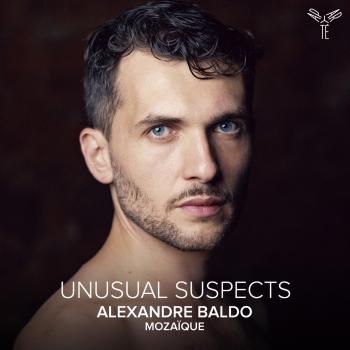
Alexandre Baldo
Laureate of the Talents Adami Classique 2023, Alexandre Baldo won the Audience Prize at the 14th Cesti International Singing Competition for Baroque Opera (2023), the First Prize and Audience Prize at the Göttinger Handel Competition in Germany and both the Note 1 Music GmbH and Fiori Musicali Prizes at the International H. I. F. Biber Competition in Austria (2021).
Since then, he has performed with Le Concert Spirituel under the direction of Hervé Niquet, with whom he made his debut in 2022 at the Opéra de Reims, singing the roles of Le Mage and L’Espagnol in Jean-Baptiste Lully’s Le Mariage forcé.
Further operatic appearances followed shortly including Antonio Sartorio’s Orfeo (Esculapio/Plutone) for both the Théâtre de l’Athénée in Paris and Théâtre Sénart under the baton of Philippe Jaroussky, the French version of La Cenerentola (Alidoro) in a Julien Lubek & Cécile Roussat staging and Die Zauberflöte (Sprecher) under Hervé Niquet, both at the Opéra Royal de Versailles. He also appeared as Plutone in Monteverdi’s L’Orfeo with Jean-Marc Aymes and Concerto Soave at the Opéra de Marseille and as Abimélech in Saint-Saëns’ Samson et Dalila under Guillaume Tourniaire at the Opéra de Saint-Etienne. He furthermore took part in the world premiere in modern times of Lully’s Le Carnaval at both the Teatro Comunale di Ferrara and the Teatro Comunale di Modena.
On the concert platform, Alexandre has sung La Resurrezione with Martin Haselböck and the Wiener Akademie at Vienna’s Musikverein, the St Matthew Passion with Thibault Noally and Les Ambassadeurs-La Grande Ecurie at the Théâtre des Champs-Elysées, Die Schöpfung (Raphael/Adam) at the Opéra de Montpellier, and Messiah with the Orchestre de l’Opéra Royal du Château de Versailles at the Abbaye de Royaumont.
At the Internationales Brucknerfest in Linz, he performed Mozart’s Requiem under the baton of Ádám Fischer leading the Orchestra of the Age of Enlightenment, as well as Bruckner’s Missa solemnis and Te Deum with the OÖ Jugendsinfonieorchester conducted by Markus Poschner.
Together with his Baroque ensemble Mozaïque, he gave a recital at the Brucknerhaus Linz and performed Emilia, a semi-scenic pasticcio based on music by Handel, at the Händelfestspiele in Halle.
Alexander Baldo’s first solo album “Caldara – Arias for Bass”, issued on the Pan Classics label, received the highest distinctions from the leading French classical music magazines Diapason (“5 Diapasons”) and Classica (“5 Étoiles”), and was nominated for the 2024 International Classical Music Awards (ICMA).
He has also recorded the world premiere of the Oratorium de Passione Domini Nostri Jesu Christi by Franz Joseph Aumann with Ars Antiqua Austria and its director Gunar Letzbor (Pan Classics), as well as Handel’s Israel in Egypt with Hervé Niquet and Le Concert Spirituel (Alpha Classics).
Highlights of the 2026/2027 season include Mozart’s Don Giovanni (Masetto) at the Opéra Royal de Versailles, Verdi’s Don Carlos (Un Moine) under Michele Spotti at the Opéra de Marseille, Beethoven’s Symphony No. 9 under Victorien Vanoosten at the Opéra de Toulon, and Handel’s Aci, Galatea e Polifemo (Polifemo) with Le Banquet Céleste at the Opéra de Rennes. Alexandre will also return to Lully’s Le Carnaval under Federico Maria Sardelli at the Theater an der Wien.
Booklet for Unusual Suspects