







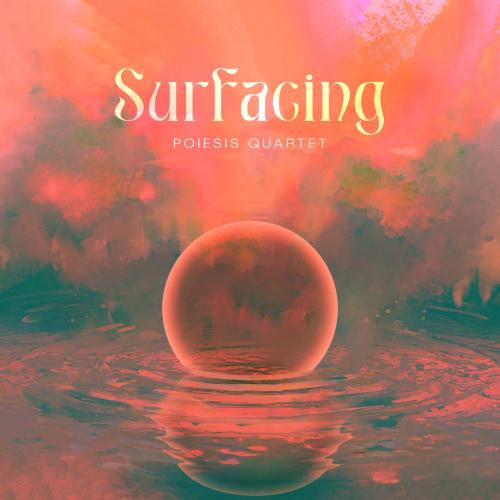
Surfacing Poiesis Quartet
Album info
Album-Release:
2026
HRA-Release:
16.10.2026
Album including Album cover
- Anonymous: String Quartet:
- 1 Anonymous: String Quartet 11:32
- 2 Anonymous: String Quartet No. 7, "Surfacing": Pt. 1 08:01
- 3 Anonymous: String Quartet No. 7, "Surfacing": Pt. 2 05:23
- 4 Anonymous: String Quartet No. 7, "Surfacing": Pt. 3 02:19
- Many Many Cadences:
- 5 Anonymous: Many Many Cadences 08:57
- Calvary (arr. by Max Ball for violin quartet):
- 6 Anonymous: Calvary (arr. by Max Ball for violin quartet) 02:44
- String Quartet No. 1, "Calvary":
- 7 Anonymous: String Quartet No. 1, "Calvary": I. Allegro 05:34
- 8 Anonymous: String Quartet No. 1, "Calvary": II. Adagio 04:32
- 9 Anonymous: String Quartet No. 1, "Calvary": III. Rondo - Allegro Vivace 05:38
Info for Surfacing
Von dem ersten Stück, das das Poiesis Quartet gemeinsam spielte (Perkinsons *Calvary*), bis hin zu ihrem allerersten Auftragswerk (Laus *Surfacing*): Das Album *Surfacing* ist eine Erkundung der musikalischen Chronologie und des künstlerischen Ethos des Quartetts. Während der prägenden gemeinsamen Jahre des Ensembles begleiteten die fantasievollen Kompositionen von Brian Raphael Nabors, Kevin Lau, Sky Macklay und Coleridge-Taylor Perkinson das Quartett auf seinem musikalischen und spirituellen Wachstumsweg. Inspiriert von ihrem Namensgeber „Poiesis“ – einem griechischen Wort für „Erschaffung“ – erweitert dieses Album die Klangwelt des Streichquartetts durch einzigartige harmonische Texturen und verspielte Rhythmen, während es sich mit Themen auseinandersetzt, die von Trauer und politischem Widerstand bis hin zu Fantasie und Humor reichen.
Poiesis Quartet:
Sarah Ying Ma, Violine
Max Ball, Violine
Jasper de Boor, Viola
Drew Dansby, Violoncello
Aufgenommen 19.–21. Januar 2026 in der Clonick Hall, Oberlin, Cincinnati, Ohio
Aufnahme, Schnitt und Mischung: Andrew Tripp
Mastering: Andrew Garver
Produktion: Elaine Martone
Poiesis Quartet:
Called a “vibrant young ensemble mid-liftoff” by The New York Times, the Poiesis Quartet has emerged as one of the most distinctive young string quartets of its generation. Formed at Oberlin Conservatory in 2022, Poiesis is the recipient of the 2026 Cleveland Quartet Award and the Grand Prize and Canadian Commission Prize at the 2025 Banff International String Quartet Competition. A 2025 performance at Caramoor was named one of The New York Times’ Best Classical Performances of the year, with the ensemble praised for its “multifaceted artistry.”
In the 2026–27 season, Poiesis maintains an expansive international schedule. Two European tours, in September 2026 and January 2027, include the Quartet’s Lucerne Festival debut and appearances in Essen, Berlin, Budapest, Hannover, and Cologne. Across North America, the Quartet performs at Strathmore, the Isabella Stewart Gardner Museum, and the Brevard Music Center, with additional engagements from Boulder, La Jolla, and Seattle to New York, Chicago, Calgary, Edmonton, Halifax, and Salt Lake City. The Cleveland Quartet Award will also bring Poiesis to a consortium of eight prominent American presenters, including Carnegie Hall, over the coming seasons.
Poiesis pairs a rich, cohesive ensemble sound with a bold understanding of what the string quartet can be. Critics have celebrated the musicians’ “palpable chemistry and remarkable warmth” (San Francisco Classical Voice) and a collective sound “rich from top to bottom” (Cleveland Classical). Collectively queer, the Quartet brings its full identity to the stage through expressive performances and programs that place canonical works in conversation with contemporary voices.
The Quartet’s name comes from the ancient Greek concept of poiesis: the act of making or bringing something new into being. For Poiesis, that idea extends beyond commissioning music. It encompasses building lasting relationships with composers, creating new contexts for familiar repertoire, and making space for stories and identities historically underrepresented in chamber music.
That conviction was fully visible at Banff, where Poiesis—the only North American ensemble selected to compete—presented an entirely contemporary final-round program featuring music by Jerod Impichchaachaaha’ Tate, Brian Raphael Nabors, Joe Hisaishi, and Kevin Lau. In addition to winning the competition’s Grand Prize, Poiesis received the Canadian Commission Prize for its interpretation of Kati Agócs’s newly commissioned Rapprochement. The Quartet’s earlier distinctions include the Grand Prize and Lift Every Voice Prize at the 2023 Fischoff National Chamber Music Competition and the Gold Medal and BIPOC Prize at the 2023 St. Paul String Quartet Competition.
For Poiesis, commissioning is an act of relationship-building as much as repertoire-building. The Quartet commissioned Chinese-Canadian composer Kevin Lau’s String Quartet No. 7, Surfacing, giving its world premiere at the Chautauqua Institution in 2025. Inspired by the fragile, nonlinear passage through trauma toward recovery, the work has become an important part of Poiesis’s touring repertoire.
That commitment also animates A Love Letter to the Queer Community, a project through which Poiesis commissioned five works by queer and trans composers of color connected to Oberlin. Premiered in March 2026, the project grew from the Quartet’s desire to collaborate with friends and give back to the community that helped bring its members together. Through these works, Poiesis centers friendship, reciprocity, experimentation, and artistic freedom while carrying the composers’ music to audiences far beyond its original community.
In July 2026, Poiesis and Caramoor presented the world premiere of Jeff Scott’s Tapestry of the Beloved Beatified, a new commission honoring four queer revolutionaries. Together, the Quartet’s work with Lau, Scott, and the composers of A Love Letter reflects an expanding body of repertoire concerned with identity, recovery, memory, and the possibility of a more inclusive future.
The Quartet’s recording projects reflect the same collaborative spirit. Its 2024 debut album, as we are, was released by Bright Shiny Things and features world-premiere recordings with mezzo-soprano Nancy Maultsby. Cleveland Classical praised the ensemble’s “bottomless depth,” while the album established Poiesis as an ensemble committed to giving new works a life beyond their premieres.
Poiesis is currently the Nina von Maltzahn String Quartet at the Curtis Institute of Music. The Quartet formerly served as Graduate Quartet-in-Residence at the University of Cincinnati College-Conservatory of Music, where it studied with the Ariel Quartet. Poiesis was also the 2025–26 Ernst Stiefel String Quartet-in-Residence at Caramoor and the 2025 St. Lawrence Emerging String Quartet at Stanford University. Previous residencies and festival experiences have taken the Quartet to Uruguay, Italy, France, and Canada. In 2024, Poiesis won Concert Artists Guild’s Louis and Susan Meisel Competition and joined the CAG roster.
The Poiesis Quartet comprises violinists Sarah Ying Ma and Coco Mi, violist Jasper de Boor, and cellist Drew Dansby. Founded at Oberlin, the Quartet was mentored in its formative years by Sibbi Bernhardsson of the Pacifica Quartet and members of the Verona Quartet. Its members’ backgrounds span Oberlin and Juilliard, solo and orchestral performance, education, and interdisciplinary work.
When not playing chamber music, the members of Poiesis love learning new languages, sharing ice cream cakes, and taking long walks on the beach.
Members of the Poiesis Quartet perform on instruments and bows generously loaned by Jonathan Solars Fine Violins.
This album contains no booklet.